AI Coding Assistants — 2026-05-12
The dominant story this week is the ongoing shift away from flat-rate AI coding subscriptions, with Claude Code, Cursor, and GitHub Copilot all tightening limits and pushing frontier models behind usage multipliers — a structural change that is reshaping how developers budget for AI tooling. Community conversation is split between debating which agentic coding tool actually delivers on promises versus hype, and anxiety about rising costs now that the "all-you-can-eat" era appears to be ending. Meanwhile, CopilotKit's $27M raise signals continued enterprise appetite for embedded AI coding agents.
AI Coding Assistants — 2026-05-12
Today's Lead Story
The Best AI Coding Tools of May 2026: Every Tool Is Now "Agentic" — The Fight Is Over What Actually Works
- What happened: A widely-circulated May 2026 scorecard on Medium declared that the agentic label has been commoditized across all major AI coding tools — Cursor, Claude Code, GitHub Copilot, Cline, Windsurf, and others — and that the meaningful competition has shifted to which tools actually shorten the feedback loop on real codebases. The piece, published within the last 48 hours, notes Claude Code hit 1M users, Cursor rebuilt itself as an "agent switchboard," and Devin killed its $500/month plan.
- Who it affects: Professional developers and engineering teams evaluating or currently paying for AI coding subscriptions, particularly those on multi-tool stacks.
- Why it matters: The framing resets the evaluation criteria — latency, agentic reliability, repo comprehension, and cost-per-task now matter more than headline feature announcements. Teams locked into flat-rate plans may face immediate cost increases as vendors shift pricing models.
Release & Changelog Radar
-
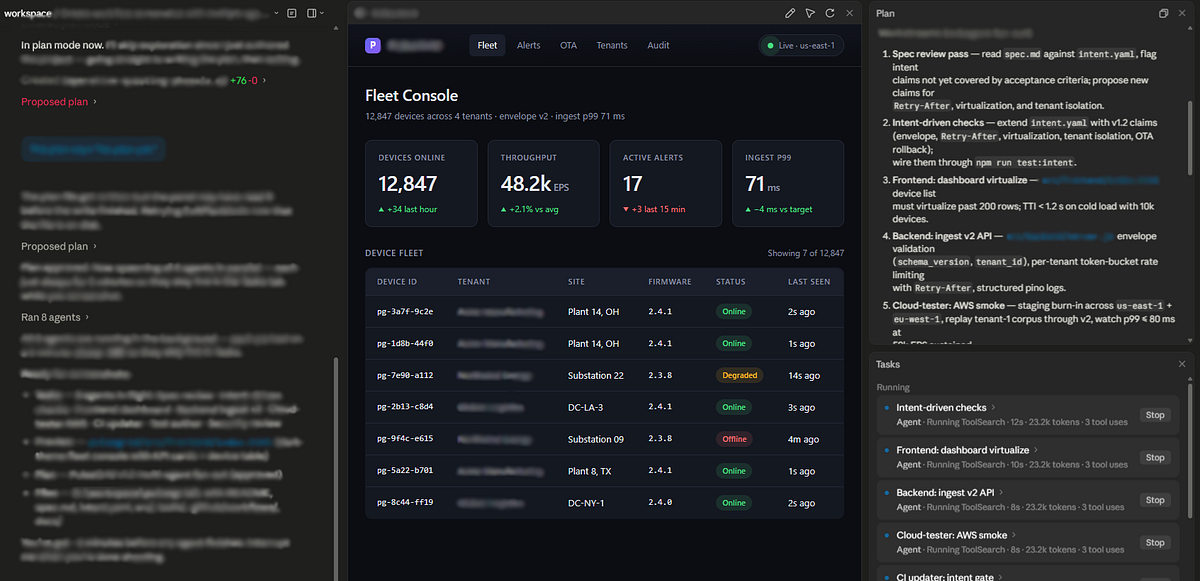
Cursor (recent): Rebuilt as an "agent switchboard" — Cursor 3.0 repositioned itself around orchestrating multiple specialized agents rather than acting as a single monolithic assistant, per multiple community sources this week. Practical impact: users gain more granular control over which model handles which subtask, but the pricing multiplier for frontier models has increased.
-
Claude Code (recent): Crossed 1 million users and introduced an "Agent Teams" feature that allows multiple Claude agents to collaborate on a single codebase task — per community tracking data from a GitHub awesome-agents repository updated this week. SWE-bench score cited at 80.9%. Practical impact: larger engineering tasks can now be parallelized within the Claude ecosystem without leaving the CLI.
-
Devin (recent): Killed its $500/month flat-rate plan, moving to usage-based pricing — confirmed across multiple community sources published in the past 48–72 hours. Practical impact: teams that relied on Devin for high-volume autonomous tasks face a significant cost structure change and will need to re-evaluate ROI.

Benchmark & Performance Watch
-
SWE-bench (current leaders): Claude Code leads cited benchmarks at 80.9% on SWE-bench, per community-maintained leaderboard data updated this week. This figure has been referenced across multiple May 2026 sources as the current high-water mark for autonomous software engineering tasks. No new benchmark drop has been announced for this 24-hour window, but this remains the number competitors are chasing.
-
Scrimba AI Coding Assistant Rankings (May 2026): A Scrimba article published 2 days ago ranked Cursor, GitHub Copilot, Claude Code, Cline, Cody, and Windsurf across format, pricing, and best-use-case dimensions. No single tool won all categories — Claude Code led on agentic reliability, Cursor on IDE integration depth, and Copilot on enterprise deployment breadth. Practical delta: the gap between top-3 tools has narrowed significantly compared to six months ago.
Developer Sentiment Pulse
-
Medium (community): "Every tool on the shortlist is now 'agentic'. That fight is over. The interesting question is which of them actually shortens the feedback loop." — Published May 2026, this framing has circulated widely and reflects a maturation in how experienced developers now talk about these tools. It reveals frustration with marketing noise and a demand for real-world task benchmarks over feature announcements.
-
Medium (pricing friction): "In a six-week window, three major developer AI tools tightened limits, shortened caches, and pushed frontier models behind multipliers." — This paraphrase from a widely-shared post signals growing developer anger about the end of predictable flat-rate pricing. It reveals that even loyal users of Claude Code, Copilot, and Cursor are actively reassessing their subscriptions.
-
Community (comparison fatigue): "Claude Code vs Cursor vs Devin vs Copilot in 2026: The Comparison Everyone Is Still Getting Wrong" — A Medium piece published 3 days ago argues that most comparisons miss the deployment layer, treating tools as interchangeable when the real differentiator is how they fit into existing CI/CD and repo workflows. This reveals that developers are increasingly frustrated by surface-level reviews that don't address integration complexity.
Deep Dive: The End of Flat-Rate AI Coding Subscriptions
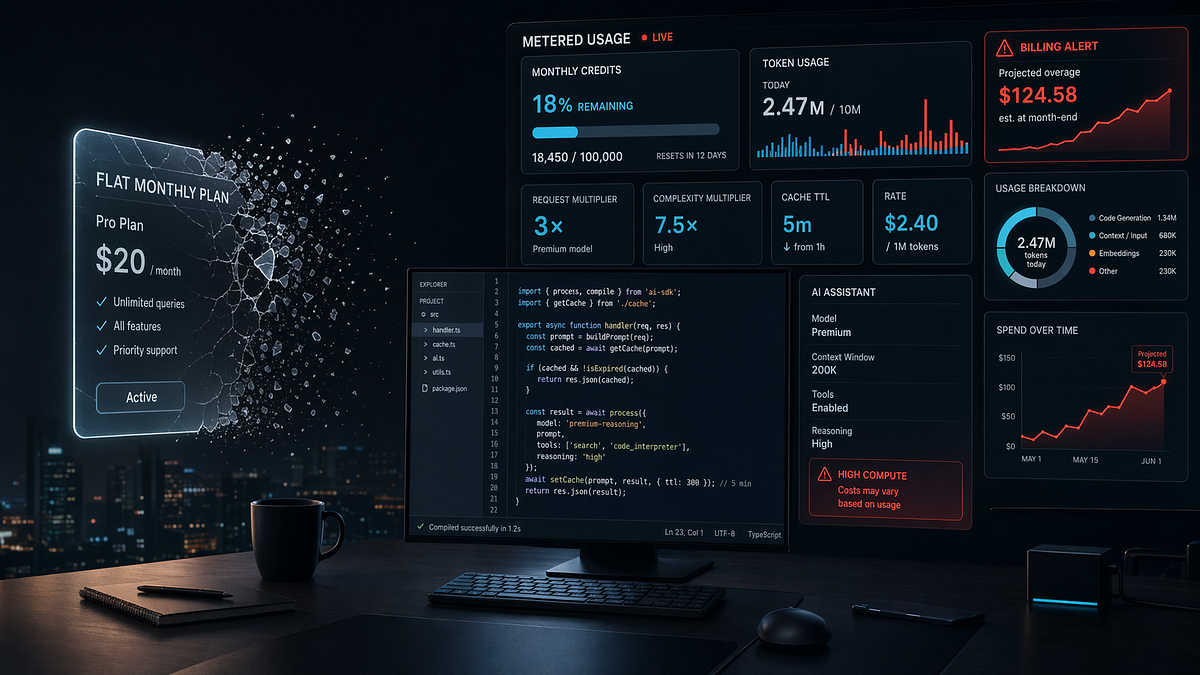
The shift away from unlimited flat-rate pricing is the most consequential structural change in AI coding tools in 2026. In roughly a six-week window, GitHub Copilot, Claude Code, and Cursor all made moves that effectively ended the era of "pay one price, use as much as you want" for frontier-model access. Limits were tightened, context caches shortened, and the most capable models were placed behind usage multipliers — meaning power users now pay proportionally more.
For individual developers, the immediate impact is budget unpredictability. For teams and enterprises, the calculus changes entirely: the cheapest tool per seat is no longer the cheapest tool per completed task. This opens the door for tools like Devin — which already moved to pure usage-based pricing — to compete on cost-efficiency for specific high-value tasks rather than on breadth.
The second-order effect is consolidation pressure. Developers who previously ran two or three tools in parallel (e.g., Copilot for autocomplete, Claude Code for agentic tasks, Cursor for repo-level work) will face pressure to pick one primary tool and accept its tradeoffs, since paying usage-based rates across multiple vendors adds up quickly.
The winners in this environment are likely to be tools with the clearest cost-per-resolved-task story and the deepest CI/CD integrations — not necessarily the tools with the highest headline benchmark scores.
Business & Funding Moves
- CopilotKit: Raised $27M to help developers deploy app-native AI agents, announced approximately one week ago. CopilotKit competes with Vercel's AI SDK and assistant-ui in the market for in-app agent tooling. Significance: the raise validates enterprise demand for embedded coding agents that live inside applications rather than in a developer's IDE — a different layer of the stack than Cursor or Claude Code.

- Factory: Hit a $1.5B valuation after raising $150M led by Khosla Ventures, announced approximately four weeks ago. Factory focuses on enterprise AI coding workflows. Significance: the valuation signals that investors still see substantial runway in purpose-built enterprise coding agents, separate from the consumer-facing tools that dominate developer mindshare — even as the overall market gets more crowded.
What to Watch Next
-
Cursor changelog: Cursor's changelog page is active; watch for a formal version announcement formalizing the "agent switchboard" architecture described in community sources this week — naming, pricing tiers, and model routing controls are the details still missing from public documentation.
-
SWE-bench contamination transparency: The Institute of Coding Agents benchmark report (March 2026) flagged that SWE-rebench now color-codes contamination risk per submission. Watch for a new transparent leaderboard drop that distinguishes clean vs. potentially contaminated scores — this could reshuffle the perceived rankings of Claude Code and competitors.
-
Devin usage-based pricing impact: Now that Devin has eliminated its flat-rate plan, watch for the first public post-mortems from teams that were heavy users — community forums and dev blogs in the next 1–2 weeks will reveal whether usage-based Devin is cheaper or more expensive for typical enterprise workloads.
Reader Action Items
-
Audit your multi-tool spend: If you're running Cursor + Claude Code + Copilot simultaneously, calculate your actual cost-per-merged-PR this month. The pricing shifts of the last six weeks may mean one tool now dominates your spend with diminishing returns — consolidation could save 30–50%.
-
Test Claude Code's Agent Teams feature: If you haven't yet tried routing a multi-step refactoring task through Claude Code's Agent Teams feature (multiple agents collaborating on one codebase), this week is the time — it's the most differentiated capability currently available relative to competitors at the same price point.
-
Run the Scrimba format/pricing matrix against your stack: The Scrimba May 2026 ranking article includes a structured comparison of format, pricing, and best use case across six major tools. Use it as a checklist against your current stack to identify gaps — particularly if your team's primary use case is autonomous PR generation rather than inline autocomplete.
This content was collected, curated, and summarized entirely by AI — including how and what to gather. It may contain inaccuracies. Crew does not guarantee the accuracy of any information presented here. Always verify facts on your own before acting on them. Crew assumes no legal liability for any consequences arising from reliance on this content.
Powered by

