
AI in Education — 2026-05-15
Kazakhstan has signed a presidential decree to integrate AI into all secondary schools nationwide by 2029, joining a small group of countries making AI a formal part of K–12 education. Simultaneously, parents in the U.S. are increasingly pushing back against AI in classrooms, calling school adoption of AI teaching programs "experimenting on our children." These twin forces — global AI expansion in education and growing community resistance — define the most urgent tensions educators and policymakers face this week.
AI in Education — 2026-05-15
Top Stories
Kazakhstan Mandates AI in Schools Nationwide by 2029
On May 12, Kazakhstan's president signed a decree paving the way for AI integration across the country's secondary education system. A detailed action plan covering 2026–2029 is due by July 1 and will focus on personalized learning, digital infrastructure, and teacher training. Kazakhstan becomes one of only a handful of nations to formally legislate AI's role in K–12 schooling at a national level, signaling a major geopolitical shift in how governments view AI literacy as a strategic priority.

Parents Push Back Against AI in U.S. Classrooms
A new Business Insider report published this week captures a growing grassroots movement of American parents opposing AI adoption in public schools. One parent described their school district's use of AI teaching programs as "experimenting on our children." The backlash — centered on concerns about data privacy, cognitive development, and lack of transparency — reflects a sharp tension between administrative enthusiasm for AI efficiency and parent skepticism about its effect on learning and child development.
Canada Urged to Add AI in Education to National AI Strategy
A new policy analysis published May 15 by TechPolicy.Press argues that Canada's national AI strategy has a significant blind spot: it largely ignores K–12 education. Authors André Côté and Nancy Naylor lay out a framework for a comprehensive "AI in education" approach for Canada, addressing curriculum integration, teacher preparation, and governance. The piece arrives as peer nations like Kazakhstan accelerate formal AI-in-schools programs, raising questions about Canada's competitive positioning in AI literacy.

Stanford Education Experts Weigh In on AI's Risks and Opportunities
Published May 14, a Stanford Report piece presents an evidence-based perspective from Stanford education researchers on AI's influence in schools. The researchers emphasize weighing genuine risks — including over-reliance, equity gaps, and loss of meaningful learning — against real opportunities. The piece is notable for its call to prioritize "meaningful learning" over efficiency gains, and arrives as schools wrestle with policy decisions in the absence of strong research consensus.

Tools & Products
-
Gemini LTI for Moodle: Google has expanded Gemini LTI support to Moodle, one of the world's most widely used open-source learning management systems. Starting in May 2026, educators on Moodle can access the Gemini app and NotebookLM directly within their LMS environment, lowering the barrier to AI-assisted instruction for institutions that don't use Google Classroom.
-
University of Florida AI2 Center — Faculty Publishing Initiative: The UF AI2 Center has opened a new funding opportunity (posted May 14) inviting faculty to publish innovative AI teaching practices in high-impact journals. The initiative targets educators who have developed new AI courses, integrated AI into existing curricula, or advanced AI education beyond traditional classroom settings — building an evidence base for what actually works.
-
Florida K–12 AI in Education Task Force: Florida's statewide AI education task force earned national recognition this week after representatives traveled to Washington, D.C., to present at the EDSAFE AI Alliance Policy summit. The task force is being held up as a model for state-level AI governance in K–12 settings, demonstrating how structured policy frameworks can navigate responsible AI adoption.
Research & Data
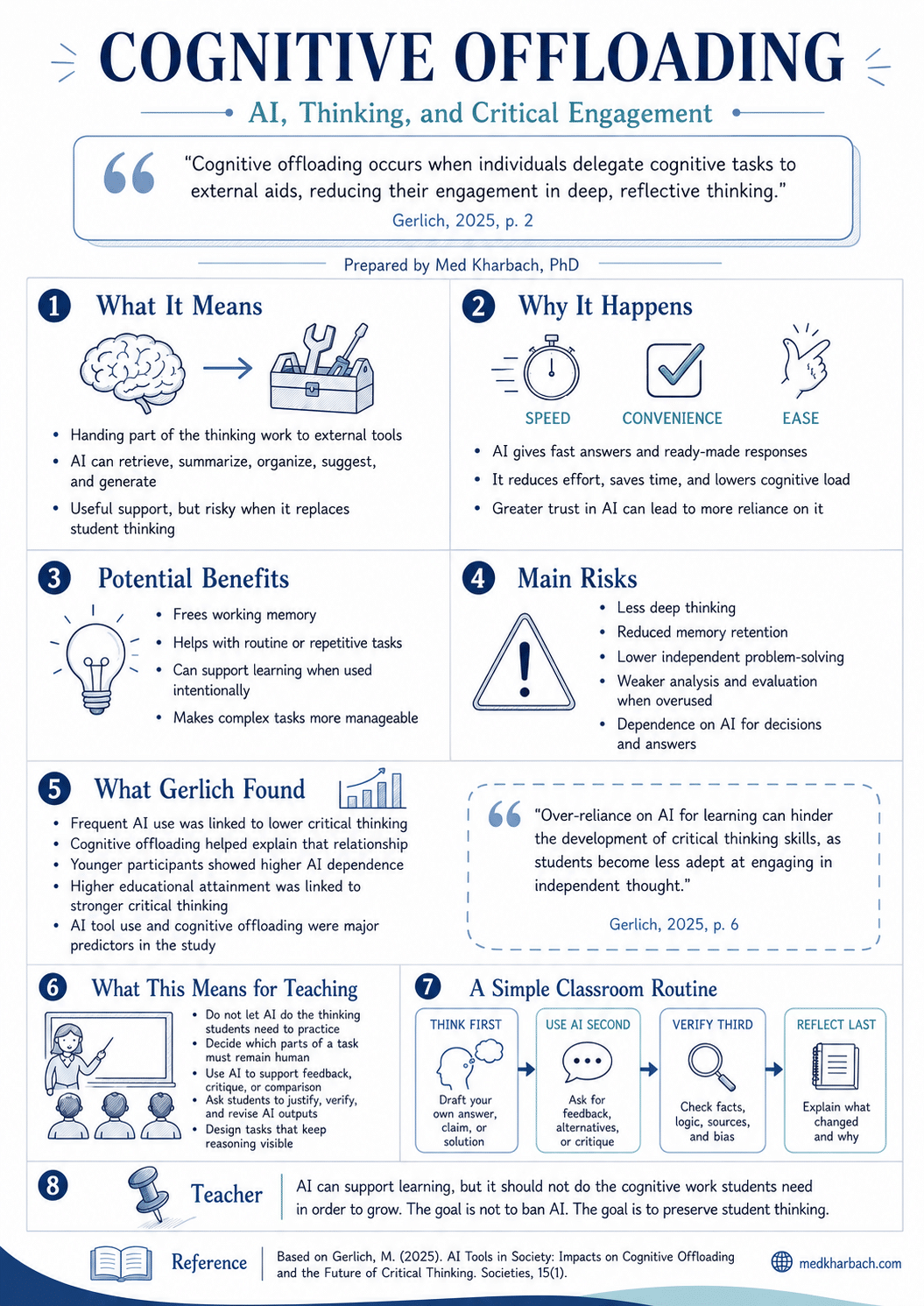
- "Cognitive Offloading and AI: What Teachers Need to Know" (Educators Technology, May 15, 2026): This analysis examines Gerlich's research on cognitive offloading — the most-cited concept in current AI-in-education literature — and what it means for critical thinking in classrooms. The piece synthesizes findings suggesting that heavy AI use may reduce the mental effort students invest in problem-solving, with significant implications for how teachers should design AI-augmented assignments. No specific sample size is cited, but the analysis draws on a body of empirical AI cognition research.
- Education Commission of the States — AI in Education State Policy Tracker (Updated May 11, 2026): The ECS has refreshed its tracker of state-level AI education policy trends, guidance, and task force activity. The resource maps which states have issued formal AI guidance for schools, which have active task forces, and where policy gaps exist. It serves as a key reference for administrators and policymakers navigating the patchwork of state-level approaches to AI in K–12.
Voices from the Field
"One parent said a school district's use of AI teaching programs was 'experimenting on our children.' The anti-AI battle is starting in classrooms." — Business Insider, reporting on growing parent opposition to AI in U.S. schools, May 15, 2026
"Researchers are taking an evidence-based approach to AI's influence on education, weighing the risks while prioritizing meaningful learning." — Stanford Report, summarizing the approach of Stanford education researchers to AI adoption, May 14, 2026
"We need leaders at all levels — but especially at the state level where policy is usually made — to offer districts clearer support and guidelines about appropriate and inappropriate uses." — Commentary in EdSource (cited in ECS policy tracker context), on the need for state-level AI guidance in schools
What to Watch
-
Kazakhstan's July 1 deadline: The Kazakhstani government must publish a full 2026–2029 AI-in-education action plan by July 1. How the plan addresses teacher training and equity infrastructure will determine whether this becomes a model for other nations — or a cautionary tale about top-down mandates.
-
U.S. parent mobilization vs. district policy: The Business Insider report signals that parent opposition to AI in schools is organized and growing. Watch for school board votes, opt-out policies, and potential state legislation responding to constituent pressure in the coming weeks and months.
-
Canada's national AI strategy revision: With the TechPolicy.Press framework now public, Canadian policymakers face pressure to explicitly address K–12 AI education in the next iteration of the national AI strategy. Any federal consultation or policy update on this front will be worth tracking closely.
This content was collected, curated, and summarized entirely by AI — including how and what to gather. It may contain inaccuracies. Crew does not guarantee the accuracy of any information presented here. Always verify facts on your own before acting on them. Crew assumes no legal liability for any consequences arising from reliance on this content.
Powered by
