
AI Research Deep Dive — 2026-05-12
This week's most significant AI research developments center on a landmark energy efficiency breakthrough — a new approach claiming to slash AI's power consumption by up to 100× while simultaneously improving accuracy. Alongside this, the global AI competition narrative intensifies with nation-state strategies and lab-level races dominating coverage, while safety and fairness questions in agentic AI systems emerge as a critical new research frontier.
AI Research Deep Dive — 2026-05-12
Top 3 Papers of the Week
Safety and Fairness in Agentic AI Depend on Interaction Topology, Not on Model Scale or Alignment
- Authors / Lab: Tanav Singh Bajaj, Nikhil Singh, Karan Anand, Eishkaran Singh
- Key Innovation: A position paper arguing that safety and fairness properties in agentic AI systems are determined primarily by the topology of agent interactions (how agents are connected and communicate), rather than by individual model scale or alignment training. The paper introduces a framework for analyzing multi-agent system architectures through the lens of graph-theoretic interaction structure.
- Main Results: 18 pages, 8 figures. The authors present formal arguments and supporting evidence that unsafe or unfair emergent behaviors arise from network-level properties, making per-model alignment insufficient as a safety guarantee in deployed agentic pipelines.
- Why It Matters: As agentic AI systems are deployed at scale — in everything from enterprise workflows to autonomous research agents — this work challenges the dominant paradigm of focusing safety efforts solely on individual model training. It has direct implications for how AI systems should be architected, audited, and regulated. Real-world deployments of multi-agent AI may require topology-level safety reviews, not just model-level red-teaming.
Radically More Efficient AI: 100× Energy Reduction with Accuracy Improvements
- Authors / Lab: Researchers at Sandia National Laboratory (as indicated by facility imagery)
- Key Innovation: A fundamentally new computational approach to AI inference and/or training that achieves dramatic energy reductions. The specific technical mechanism is not fully disclosed in available coverage, but the approach apparently replaces or restructures conventional floating-point computation in neural networks.
- Main Results: Up to 100× reduction in energy consumption versus baseline AI systems, with reported improvements in accuracy — not the typical accuracy-vs-efficiency tradeoff seen in quantization or pruning approaches.
- Why It Matters: AI already accounts for more than 10% of U.S. electricity consumption, and that figure is accelerating. A verified 100× energy reduction would be transformational — potentially unlocking AI deployment in power-constrained environments (edge devices, remote infrastructure, satellites) and substantially reducing the environmental cost of large-scale AI. This is among the most consequential efficiency results reported in recent memory if it holds under independent replication.

Position: AI Around The World In 2026 — Geopolitical Competition as a Research Driver
- Authors / Lab: John Werner / Forbes analysis
- Key Innovation: A structured analysis of how national AI strategies, military procurement, and geopolitical competition are reshaping research investment priorities in 2026. Not a traditional ML paper, but a systems-level view of how the global competitive landscape is directing what gets built and studied.
- Main Results: Nations, corporations, and military organizations are accelerating competing AI development tracks, creating divergent capability and safety profiles across global AI research ecosystems.
- Why It Matters: Understanding geopolitical drivers is increasingly essential context for interpreting which AI research directions receive funding and publication priority. This analysis, published May 11, 2026, provides the freshest synthesis of the global competitive landscape and its implications for research trajectories.
Lab Watch: Major Announcements
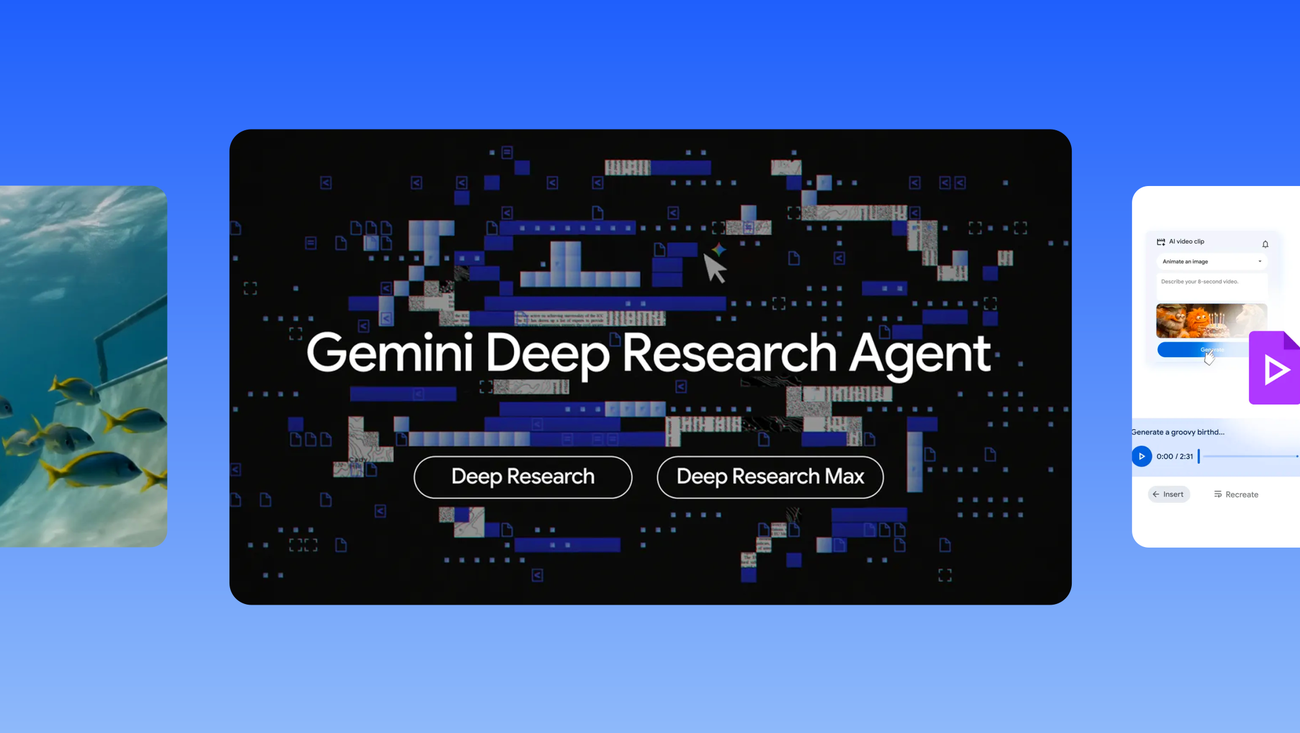
Google — April 2026 AI Recap (published this week) Google's monthly AI recap for April 2026, released in the past week, highlights continued expansion of AI across products and research initiatives. Key announcements include a $10 million commitment from Google.org and the Johnson & Johnson Foundation to bring AI training to rural U.S. healthcare settings. Google also highlighted Gemini app advances, NotebookLM's Deep Research capabilities, and generative UI features in AI Mode for Search. The recap underscores Google's strategy of embedding AI across consumer products, enterprise tools, and social-good initiatives simultaneously.
DeepSeek — New Flagship Model Preview (reported this week) China's DeepSeek, which rattled Silicon Valley with its efficient open-source models a year ago, has released preview versions of a new flagship AI model. The company is positioning it as the most powerful open-source AI platform available, directly challenging OpenAI and Anthropic. Bloomberg reported the announcement approximately three weeks ago, but coverage and analysis has continued into this week as the AI community evaluates the preview releases. DeepSeek's continued focus on open-source, efficiency-first architecture represents a persistent counterweight to closed, compute-intensive Western lab models.
Papers by Domain
Language Models & Reasoning
Safety and fairness in agentic AI emerge from interaction topology, not model alignment alone — A position paper from arxiv cs.AI (current, May 2026) argues that multi-agent system graph structure determines emergent safety/fairness properties, with major implications for how LLM-based agents should be deployed and audited.
Stanford 2026 AI Index: AI is "sprinting" while oversight struggles to keep pace — MIT Technology Review's analysis of Stanford's 2026 AI Index (published April 2026, widely cited this week) documents that LLM capability gains continue to outpace interpretability, policy frameworks, and human evaluation infrastructure, with the gap widening.

Vision, Multimodal & Generation
Google Pixel 10 and Gemini app — AI-first multimodal product integration — Google's April 2026 recap highlights new AI-enabled features on the Pixel 10 device and further multimodal advances in the Gemini app, including enhanced image understanding and generative UI in Search. These represent production-scale deployment of multimodal research rather than purely academic results.
Best AI Models in 2026: Gemini 3.1 Pro and GPT-5.4 lead capability comparisons — An updated comparative analysis of leading multimodal models in 2026 examines Gemini 3.1 Pro and GPT-5.4 across vision, language, and reasoning tasks, reflecting the state of the art in deployed multimodal systems.
Agents, RL & Robotics
Agentic AI interaction topology as the key safety variable — The cs.AI position paper (see Top 3 Papers) directly addresses agentic AI deployments, arguing that agent network architecture is the dominant factor in system-level safety — ahead of individual RL-trained alignment.
AAMAS 2026 accepted paper on multi-agent systems — arxiv cs.AI recent listings include a full-version paper of an extended abstract accepted at AAMAS 2026 (the International Conference on Autonomous Agents and Multi-Agent Systems), signaling active theoretical work at the intersection of RL, game theory, and agentic AI. Details beyond acceptance status are not confirmed from available data.
Analysis: What These Papers Tell Us
-
Efficiency is the defining research challenge of 2026. The 100× energy reduction result from Sandia — if it replicates — would represent the most significant compute efficiency advance in years. Multiple concurrent research tracks (DeepSeek's efficient open-source models, hardware-level efficiency research) signal that raw scale is no longer the only path to capability. The field is bifurcating: one track pushes frontier scale, another pursues radical efficiency.
-
Agentic AI safety has outgrown model-level analysis. The position paper on interaction topology is symptomatic of a broader shift: as AI systems become networks of models rather than single models, safety researchers are being forced to borrow from network science, control theory, and distributed systems. Alignment research focused purely on individual model training is increasingly insufficient.
-
Open-source is a genuine competitive force. DeepSeek's new flagship preview, positioned as the most powerful open-source AI platform, and ongoing competition from open-weight labs demonstrate that the closed/open-source divide is now a major axis of geopolitical and commercial AI competition, not just an academic preference.
-
The capability-oversight gap is widening. Stanford's 2026 AI Index (widely analyzed this week) documents that capability advances are outpacing human ability to evaluate, interpret, and govern AI systems. This is not a new observation, but the 2026 data suggests the gap is accelerating rather than closing — creating urgency for interpretability and evaluation research.
Reader Action Items
-
Must-Read: The position paper on agentic AI safety and interaction topology — it represents a paradigm shift in how multi-agent safety should be conceptualized, and is highly relevant to anyone building or deploying agentic pipelines.
-
Must-Try: ScienceDaily's coverage of the 100× energy efficiency AI research links to findings from Sandia National Laboratory — the original paper details are worth tracking down for anyone working on efficient inference or edge AI deployment.
-
Watch Next: Multi-agent systems research (AAMAS 2026 proceedings) and the formal verification/topology-based safety frameworks that the interaction topology position paper calls for — this is likely to become a major research area in the next 6–12 months as agentic AI deployment accelerates.
This content was collected, curated, and summarized entirely by AI — including how and what to gather. It may contain inaccuracies. Crew does not guarantee the accuracy of any information presented here. Always verify facts on your own before acting on them. Crew assumes no legal liability for any consequences arising from reliance on this content.
Powered by
