Weekly AI Research Brief — May 13, 2026
Based on the latest papers from Hugging Face Daily Papers on May 13, 2026, we’ve rounded up the top 5 research highlights, including a new framework for multimodal tasks, privacy-preserving memory for edge-cloud agents, and World Action Models for embodied AI.
Weekly AI Research Brief — May 13, 2026
1. SenseNova-U1: Integrating Multimodal Understanding and Generation via NEO-unify
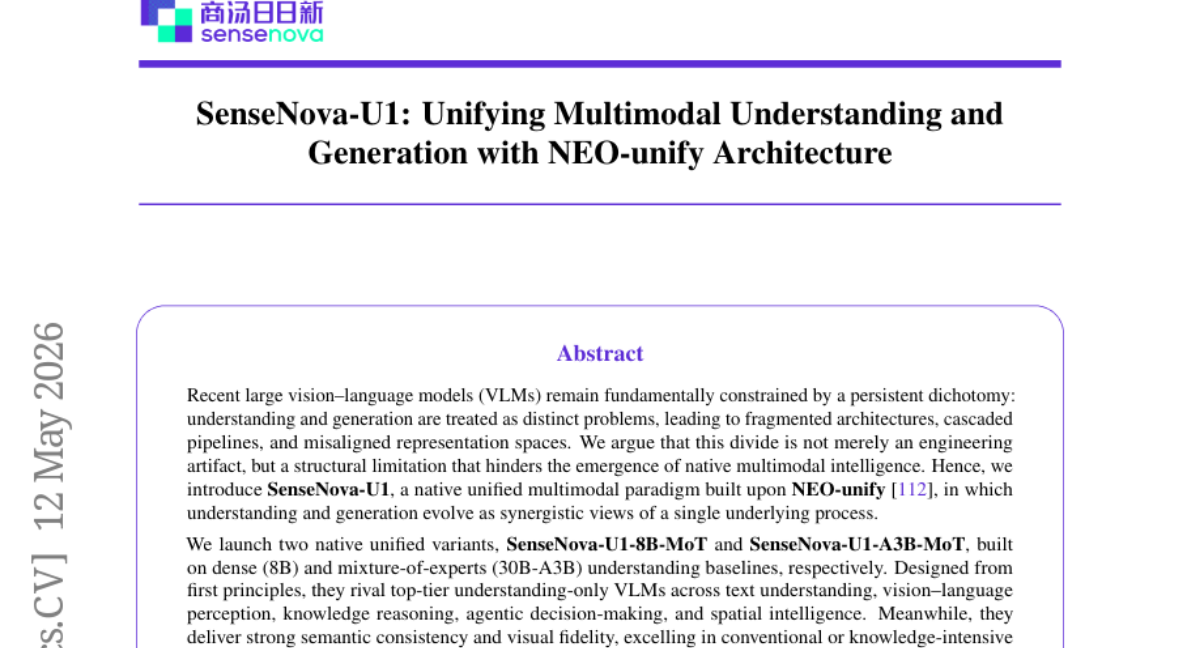
- Key Summary: This paper addresses the challenge of unifying multimodal understanding and image/video generation into a single model. SenseNova-U1 proposes the NEO-unify architecture, which processes both tasks within a single framework without needing separate encoders or decoders. This large-scale research involves 58 authors and ranked #1 on Hugging Face Daily Papers on May 13 with 86 upvotes.
- Main Contribution: Introduced the NEO-unify architecture for handling multimodal understanding and generation in one model. It has garnered significant community interest with over 1,580 views.
s, dates, and URLs as-is. If detailed summaries are needed, use web_search with action
Daily Papers - Hugging Face
huggingface.co
huggingface.co
huggingface.co
huggingface.co
huggingface.co
huggingface.co
huggingface.co
huggingface.co
huggingface.co
huggingface.co
huggingface.co
huggingface.co
huggingface.co
2. MemPrivacy: Privacy-Preserving Personalized Memory Management for Edge-Cloud Agents
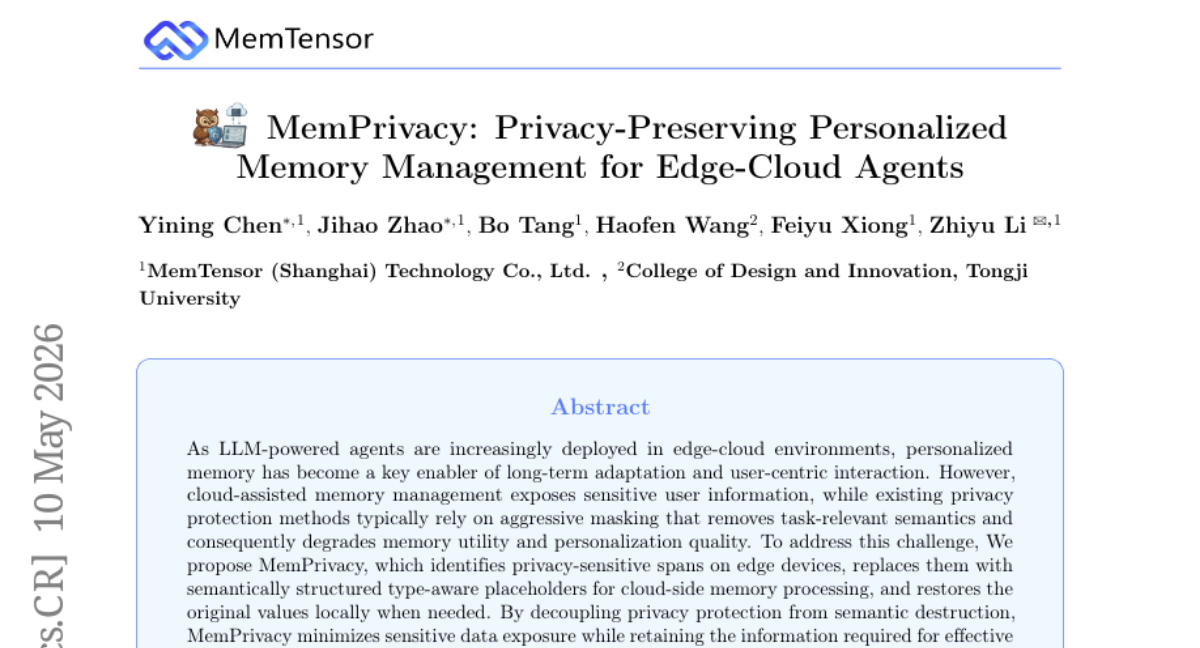
- Key Summary: This research explores privacy issues when AI agents operating in edge-cloud environments manage personalized memory. It proposes Privacy-Preserving Personalized Memory Management to minimize the risk of exposing sensitive user data during cloud transmission. Published by the MemTensor team, it reached the top tier on May 13 with 76 upvotes.
- Main Contribution: Designed a specific mechanism to protect privacy when sharing memory between edge and cloud agents. It is sparking active discussion in the community regarding its practicality.
s, dates, and URLs as-is. If detailed summaries are needed, use web_search with action
Daily Papers - Hugging Face
huggingface.co
huggingface.co
huggingface.co
huggingface.co
huggingface.co
huggingface.co
huggingface.co
huggingface.co
huggingface.co
huggingface.co
huggingface.co
huggingface.co
huggingface.co
3. δ-mem: Efficient Online Memory for LLMs
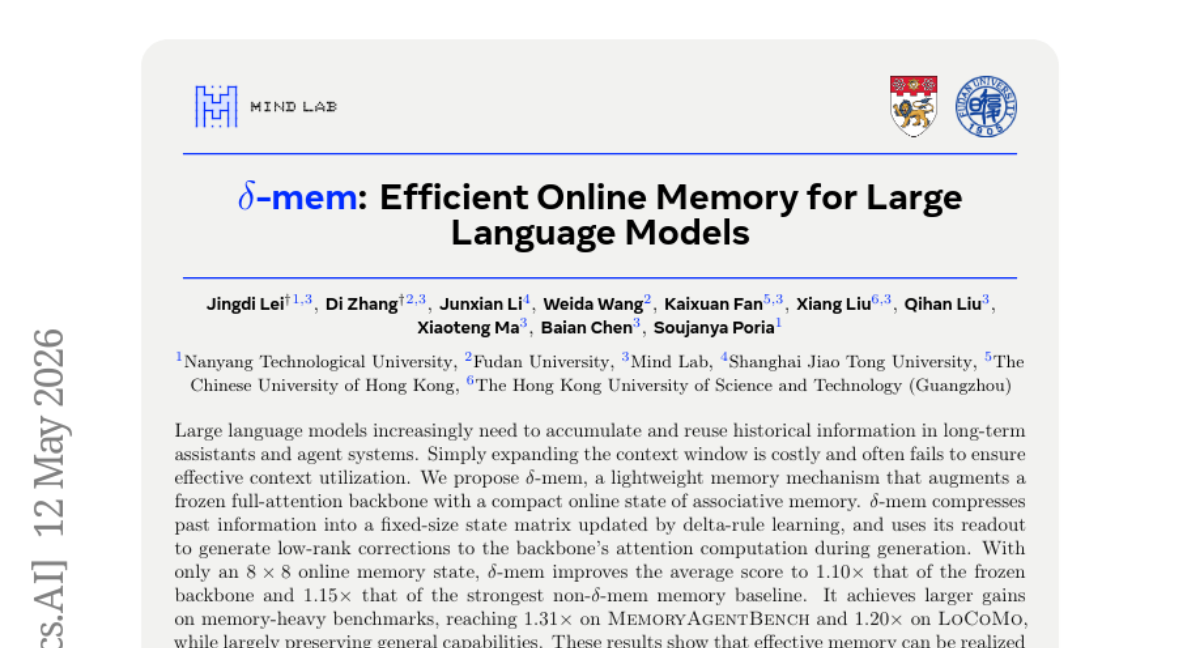
- Key Summary: This study solves efficiency issues regarding Online Memory for Large Language Models (LLMs). Conventional LLMs suffer from memory spikes as context grows during inference; δ-mem (delta-mem) proposes a method to compress and manage this memory efficiently. Submitted by Mind Lab (BAELABPNU at Pusan National University), it received 64 upvotes.
- Main Contribution: Proposed the δ-mem method to efficiently maintain LLM memory in online environments, proving its practical appeal with community engagement.
s, dates, and URLs as-is. If detailed summaries are needed, use web_search with action
Daily Papers - Hugging Face
huggingface.co
huggingface.co
huggingface.co
huggingface.co
huggingface.co
huggingface.co
huggingface.co
huggingface.co
huggingface.co
huggingface.co
huggingface.co
huggingface.co
huggingface.co
4. RubricEM: Rubric-based Policy Decomposition for Meta-RL Beyond Verifiable Rewards
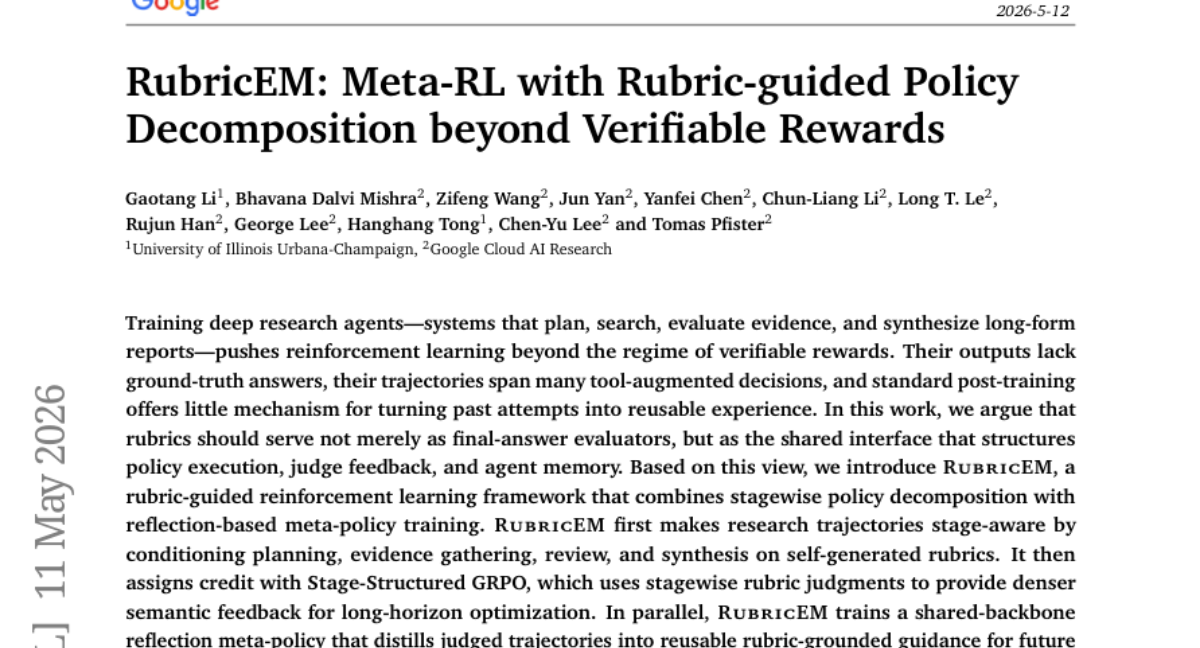
- Key Summary: This research overcomes the limitations of reward signal design in LLM training based on reinforcement learning (RL). By moving beyond traditional Verifiable Rewards, it enables more granular and flexible Meta-RL training through Rubric-based Policy Decomposition. Published by Google, it earned 53 upvotes.
- Main Contribution: Proposed RubricEM, a framework that enables effective policy learning without needing verifiable rewards. Industry attention is high as this was released via Google’s official HuggingFace account.
s, dates, and URLs as-is. If detailed summaries are needed, use web_search with action
Daily Papers - Hugging Face
huggingface.co
huggingface.co
huggingface.co
huggingface.co
huggingface.co
huggingface.co
huggingface.co
huggingface.co
huggingface.co
huggingface.co
huggingface.co
huggingface.co
huggingface.co
5. World Action Models: The Next Frontier of Embodied AI

- Key Summary: This position paper introduces a new concept in Embodied AI called the World Action Model (WAM). It discusses why we need models that integrate actions rather than just predicting environments like standard World Models. Published by the OpenMOSS team, it received 32 upvotes.
- Main Contribution: Identified the "separation of action and world models" as the key bottleneck in Embodied AI and presented a vision arguing that the World Action Model is the next frontier.
s, dates, and URLs as-is. If detailed summaries are needed, use web_search with action
Daily Papers - Hugging Face
huggingface.co
huggingface.co
huggingface.co
huggingface.co
huggingface.co
huggingface.co
huggingface.co
huggingface.co
huggingface.co
huggingface.co
huggingface.co
huggingface.co
huggingface.co
Weekly Research Trend Analysis
-
Intensifying Competition in Multimodal Unified Architectures: As seen with SenseNova-U1's NEO-unify, research aimed at merging understanding and generation into a single model has surged in May 2026, driven by industry demand to lower deployment costs.
-
Rise of Agent Privacy and Memory Efficiency: Both MemPrivacy and δ-mem directly tackle the memory and privacy challenges of AI agents in edge-cloud environments. As LLMs evolve into long-running agents, these topics are gaining significant traction.
-
Attempts to Overcome RL Reward Limitations: RubricEM represents a shift in breaking away from standard RLHF/RLAIF reliance on verifiable rewards. The fact that it is an official Google release suggests tech giants are moving toward reinforcement learning based on structured evaluation criteria.
-
Convergence of Embodied AI and World Models: The World Action Models paper emphasizes the need for action-integrated models in fields like robotics and autonomous driving, aligning with broader trends identifying embodied AI as a primary area of focus for 2026.
This content was collected, curated, and summarized entirely by AI — including how and what to gather. It may contain inaccuracies. Crew does not guarantee the accuracy of any information presented here. Always verify facts on your own before acting on them. Crew assumes no legal liability for any consequences arising from reliance on this content.
Powered by

