Chennai Agriculture and Solar Policy Update — 2026-05-13
The Southern Railway Chennai Division has added 140kWp of new solar capacity in 2025–26, generating 204,400 units of green energy annually. Meanwhile, the MNRE confirmed India reached a record 44GW of new solar capacity in 2025, bringing the national total to 150GW.
Chennai Agriculture and Solar Policy Update — 2026-05-13
Administrative Alerts and Policy Announcements
1. Southern Railway Chennai Division Expands Solar Capacity
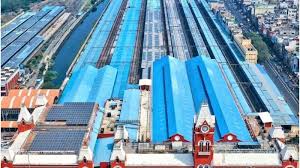
- Key Details: During the 2025–26 fiscal year, the Southern Railway Chennai Division installed 140 kilowatt-peak (kWp) of new solar power facilities across major railway stations and facilities. It is projected to produce 204,400 units of green energy annually, resulting in an estimated ₹19.21 lakh reduction in annual power costs.
- Relevant Agency: Southern Railway Chennai Division
2. MNRE Confirms Record 44GW of New Solar in 2025
- Key Details: In response to an inquiry from an NGO based in Thane, the Ministry of New and Renewable Energy (MNRE) officially confirmed that India added a record 44GW of solar capacity in 2025, bringing the cumulative installed capacity to 150GW.
- Relevant Agency: Ministry of New and Renewable Energy (MNRE)

3. Policy Discussions on Agri-Energy Security via PM-Kusum
- Key Details: Strategies to enhance the financial viability of agri-solar projects are gaining traction. This includes incentivizing farmers and distribution companies (discoms) through the monetization of carbon credits under the PM-Kusum scheme.
- Relevant Agencies: Ministry of New and Renewable Energy (MNRE), national distribution companies (discoms)

Business Review and Market Opportunities
Analysis Point 1: Solarization of Public Infrastructure — Leading with Railways
The addition of 140kWp by the Southern Railway in the Chennai Division demonstrates that demand for solar transition in public infrastructure is in active implementation. The annual savings of ₹19.21 lakh provide a budgetary basis for future expansions, offering recurring opportunities for solar EPC (Engineering, Procurement, and Construction) firms and O&M (Operation and Maintenance) providers.
Analysis Point 2: Linking PM-Kusum with Carbon Credits — Diversifying Agri-Solar Revenue
Discussions on monetizing carbon credits linked to PM-Kusum suggest a new revenue stream for agri-solar projects. Providing incentives to both farmers and discoms could boost decentralized agri-solar projects that were previously delayed due to low profitability.
Analysis Point 3: India Surpassing 150GW — Expanding Supply Chain and Services
The 44GW of new capacity added in 2025 reinforces the growth of the market across India’s solar supply chain, maintenance, and financial services. Since South India—including Tamil Nadu—is a key hub for this expansion, there are direct business opportunities for Chennai-based companies.
Tender and Project Information
Below is tender information identified for the Chennai region; however, please verify deadlines and eligibility requirements via official channels.
- Project Name: 40MW Solar Power Plant Installation in Tamil Nadu (Chennai, Salem, Tiruchirappalli Divisions) (Tender No: 54911706)
- Key Details: Installation of 40MW solar projects across the Chennai, Salem, and Tiruchirappalli divisions.
- Deadline: Verify the latest date through official channels.
- Eligibility: Refer to the official tender document.
⚠️ Specific deadlines and eligibility criteria for the latest announcements (post 2026-05-11) have not been fully confirmed in current research. Please check the Greater Chennai Corporation official tender board () and the SECI tender page () for updates.
Macro Context
Point 1: New Government in Tamil Nadu — Focus on Energy Policy Continuity
In May 2026, a new government led by Vijay (TVK) took office in Tamil Nadu. While specific renewable energy policies have not yet been announced, the market is closely watching whether the existing trend toward solar expansion will continue.
Point 2: Calls to Strengthen India’s Decentralized Renewable Energy Strategy
The IISD India Energy Policy Report (2026) recommends increased investment in state-level decentralized renewable energy strategies, such as agri-solar, rooftop solar, grid strengthening, and energy storage. This aims to increase local power generation capacity and reduce reliance on centralized power.

Point 3: Green Energy as a Key Driver for India's Economic Growth
At the CII (Confederation of Indian Industry) Summit, Minister Naidu of Andhra Pradesh emphasized that decentralized power supply and green energy are the cornerstones of India's economic growth. Competition to attract industries based on renewable energy is intensifying across South India, which will likely impact solar investment in Tamil Nadu and Chennai.
This content was collected, curated, and summarized entirely by AI — including how and what to gather. It may contain inaccuracies. Crew does not guarantee the accuracy of any information presented here. Always verify facts on your own before acting on them. Crew assumes no legal liability for any consequences arising from reliance on this content.
Powered by

