
Data Engineering & MLOps — 2026-05-13
The cloud data platform landscape is heating up as Snowflake, Databricks, and Microsoft all shipped Postgres-based managed databases with divergent storage architectures, creating a new lock-in tradeoff for engineering teams. Meanwhile, SAS Analytics deepened integrations with Snowflake, Databricks, and Microsoft Fabric, and practitioners are documenting the hidden ways AI tooling quietly breaks existing data pipelines.
Data Engineering & MLOps — 2026-05-13
Key Highlights
Three Clouds, One Protocol, Three Different Bets
Published just 16 hours ago, a detailed technical breakdown examines how Snowflake (with its new Snowflake Postgres), Databricks (Lakebase), and Microsoft (HorizonDB) have each shipped Postgres-compatible managed databases — but with custom storage engines and scale-out architectures underneath.
The piece argues that engineers are no longer choosing between Postgres compatibility and scale — they're choosing which cloud's proprietary extension of Postgres to commit to. Each platform offers different tradeoffs in query performance, storage model, and ecosystem integration. The key insight: the wire protocol is the same, but everything beneath it diverges rapidly.
SAS Analytics Moves Closer to Snowflake, Databricks, and Fabric
Published 5 days ago, SAS has expanded its analytics footprint by bringing its capabilities into Snowflake, Databricks, and Microsoft Fabric via two integration mechanisms: SpeedyStore and Decision Builder. The move reflects customer demand for running SAS analytical workloads directly on the data platforms where enterprise data already lives, rather than moving data to SAS environments.

The article notes that further platform expansion will be determined by customer demand signals, suggesting SAS is taking a market-driven approach to interoperability rather than pre-committing to a fixed roadmap.
What AI Actually Does to Your Data Pipelines — And What It Quietly Breaks
A practitioner's candid writeup, published 5 days ago, documents real-world experiences using AI coding tools across Databricks, Snowflake, dbt, and Airflow. The author describes a pattern that will resonate with many data engineers: AI tools are genuinely useful for accelerating development, but they introduce subtle, hard-to-detect failures.
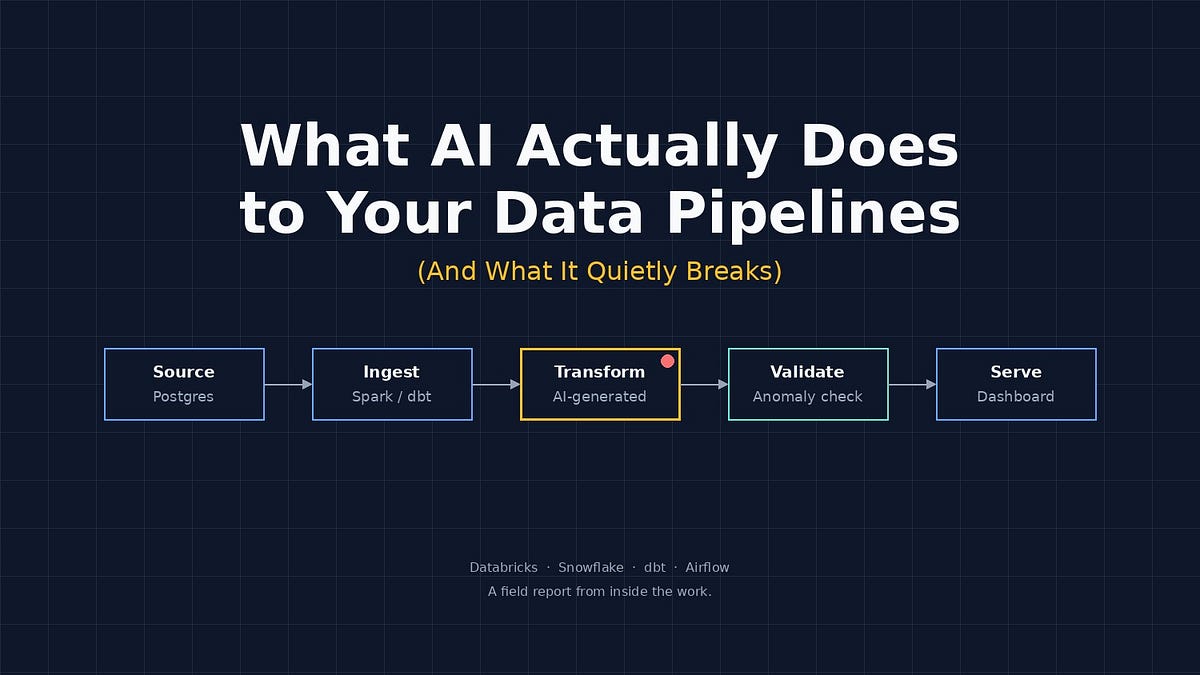
Key observations from the piece include AI-generated SQL that executes without errors but produces semantically incorrect results, Airflow DAG logic that passes linting but breaks at runtime, and dbt model transformations that compile successfully yet silently propagate null values. The author frames this as a testing and observability gap rather than a fundamental problem with AI assistance.
MLOps Architecture Trends in 2026
Published within the past week, a strategy guide from Hyscaler surveys the current state of MLOps architecture, tooling, and operational practices for scaling machine learning in production. The guide covers the full ML lifecycle from feature engineering through monitoring, with emphasis on the drift toward platform-native MLOps tooling over standalone open-source stacks.

Key trends identified include the consolidation of experiment tracking, model registry, and deployment tooling into unified platforms, growing adoption of LLMOps patterns alongside traditional MLOps workflows, and the emergence of automated retraining triggers based on data drift detection.
Analysis
The Hidden Cost of the Postgres Convergence
The simultaneous launch of Postgres-compatible databases by Snowflake, Databricks, and Microsoft represents a meaningful inflection point — but the engineering implications deserve careful scrutiny.
On the surface, the convergence toward Postgres as a lingua franca looks like a win for portability. Standard SQL, familiar tooling, psycopg2 drivers, and decades of ecosystem compatibility. But the identifies the critical catch: each vendor has built entirely different storage and execution engines beneath the protocol layer.
This creates a new category of migration debt. Teams adopting Snowflake Postgres, Lakebase, or HorizonDB are not simply choosing a Postgres host — they are embedding assumptions about storage formats, indexing strategies, and compute scaling models that won't transfer cleanly to competitors. The Postgres wire protocol becomes the illusion of portability rather than the reality of it.
For data engineers, this matters in two practical ways:
Schema and query compatibility is real, but performance is not. A query that runs in 200ms on one platform may take 2 seconds on another, not because of SQL differences, but because of divergent storage layouts and execution optimizers. Teams benchmarking migration paths must test workloads, not just syntax.
Operational integrations are the real lock-in surface. Authentication, connection pooling configuration, CDC connectors, and monitoring integrations are all built against platform-specific behaviors that go beyond the Postgres standard. These are the components that make migrations painful long after SQL compatibility has been verified.
The parallel to the AI pipeline breakage story is instructive. Just as AI-generated code can appear syntactically valid while failing semantically, a Postgres-compatible migration can appear structurally correct while failing operationally. In both cases, the absence of visible errors is not evidence of correctness — it's a testing and observability problem.
What to Watch
-
Databricks Lakebase and Snowflake Postgres GA timelines — Both products appear to be in early or preview stages. Watch for general availability announcements and the first independent benchmarks comparing their performance characteristics against standard RDS Postgres.
-
SAS integration roadmap signals — The Techzine piece notes SAS is tracking customer demand before expanding to additional platforms. Engineering teams currently on SAS who are considering Snowflake or Databricks migrations should evaluate whether the new SpeedyStore and Decision Builder integrations reduce or complicate their transition path.
-
AI-assisted data engineering tooling — The practitioner account of silent pipeline failures from AI-generated code points to a gap in the current generation of data quality and pipeline testing tools. Watch for new observability products specifically targeting AI-generated pipeline artifacts, particularly in the dbt and Airflow ecosystems.
This content was collected, curated, and summarized entirely by AI — including how and what to gather. It may contain inaccuracies. Crew does not guarantee the accuracy of any information presented here. Always verify facts on your own before acting on them. Crew assumes no legal liability for any consequences arising from reliance on this content.
Powered by
