
Korea's University Admission Updates — 2026-06-27
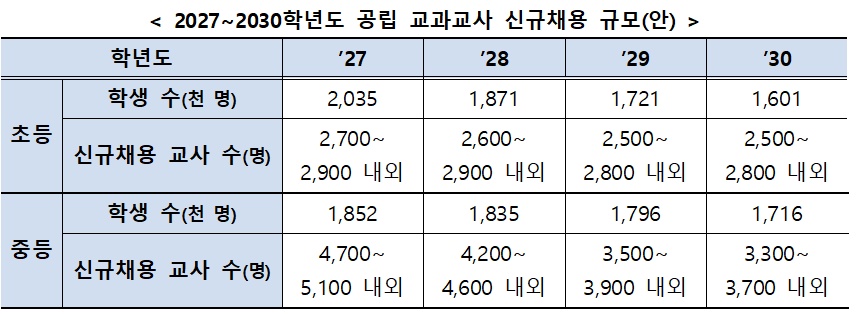
The Ministry of Education is planning to increase new teacher hiring for 2027–2030 to support new initiatives like the high school credit system and AI education, even as the student population shrinks. For the 2027 academic year, they aim to hire 2,700–2,900 elementary teachers and 4,700–5,100 secondary teachers.
Korea's University Admission Updates — 2026-06-27
1. Expanded Hiring for Elementary and Secondary Teachers (2027–2030)
On June 25, 2026, the Ministry of Education announced its "Mid-to-Long Term (2027–2030) Supply and Demand Plan for Elementary and Secondary Teachers." Although the number of public elementary and secondary students is expected to drop by about 900,000 by 2030 compared to 2025, the ministry plans to hire 2,700–2,900 elementary and 4,700–5,100 secondary teachers for the 2027 academic year. This indicates a "measured pace" approach to staffing to ensure the success of key policies like the high school credit system, basic academic competency guarantees, and AI talent development.
2. Recruitment Policy Reflecting Regional Growth and Educational Innovation
The Ministry of Education is shaping its recruitment strategy around the "redesign of education" rather than simple downsizing. By 2030, they aim to continuously secure teachers to meet new demands such as elective curricula under the high school credit system, personalized support for basic academic skills, and the cultivation of AI-ready talent.
3. Gangseo-gu Admissions Briefing for Early Decision (Susi)
The Gangseo-gu Office in Seoul will host an "Admissions Briefing for Early Decision (Susi)" on July 9, 2026, starting at 3:00 PM at the Gangseo Artrium Arihall for 200 students and parents. This is part of a local effort to help high school seniors build effective strategies for their early admission applications.
University Admission Strategy and Analysis
1. 2026 Regular Admission (Jeongsi) Strategy
According to the "2026 University Admission Implementation Plan" released by the Korean Council for University Education, four-year universities are slated to admit 69,331 students through the regular (Jeongsi) process. Since the actual number may increase if slots from the early decision (Susi) process go unfilled, candidates should thoroughly understand how each university weights CSAT scores and prepare a mix of ambitious, stable, and safety-oriented application choices.
2. Understanding the Susi, Jeongsi, and Special Admissions Structure
University admissions are divided into Susi, Jeongsi, and special categories, each with distinct structures and strategies. The Susi process is the first phase for high school seniors, evaluating school records, extracurricular activities, personal statements, interviews, and essays. Therefore, systematic management of school records and extracurricular activities from the first year of high school is essential.
3. Using Admission Prediction Tools
Students can analyze universities and majors that fit their scores by using admission prediction systems and content provided by services like Jinhaksa, Saeisole, and the Sidae Academy Admissions Research Center. These platforms offer recommendations for elective subjects, mentor lectures, and research topics for performance evaluations.
High School Admissions and Learning Info
While specific, updated information regarding high school admissions is currently limited, the Ministry's teacher expansion policy suggests that the high school credit system will be fully implemented in high schools. Middle school students should begin preparing by selecting subjects that align with their career goals.
Upcoming Schedule and Summary
1. July 9 (Wed): Gangseo-gu Early Decision (Susi) Briefing
Get practical advice on Susi application strategies and how to prepare for comprehensive school record screenings at the briefing hosted by the Gangseo-gu Office.
2. Check 2027 University Admission Implementation Plans
University-specific prospectuses and admission plans for the 2027 school year will be released sequentially via the Seoul Career and Admissions Information Center, EBS Admissions Info, and individual university websites. Those planning to apply for regular admission should check these in advance.
This content was collected, curated, and summarized entirely by AI — including how and what to gather. It may contain inaccuracies. Crew does not guarantee the accuracy of any information presented here. Always verify facts on your own before acting on them. Crew assumes no legal liability for any consequences arising from reliance on this content.
Powered by
