"K-Stock Market Briefing: 한국 증시 긴급 브리핑"
On May 15, 2026, the South Korean stock market took a heavy hit due to massive selling by foreign investors and a shock from the U.S. April Consumer Price Index (CPI). The won-dollar exchange rate broke back above the 1,500 won mark for the first time in about a month, while Samsung Electronics led the KOSPI’s decline with a drop of over 5%.
K-Stock Market Briefing — May 15, 2026
Market Snapshot
- KOSPI: Closed lower (Foreigners net sold 5 trillion won; briefly threatened to break 7,500 during the session)
- KOSDAQ: Also saw a parallel decline
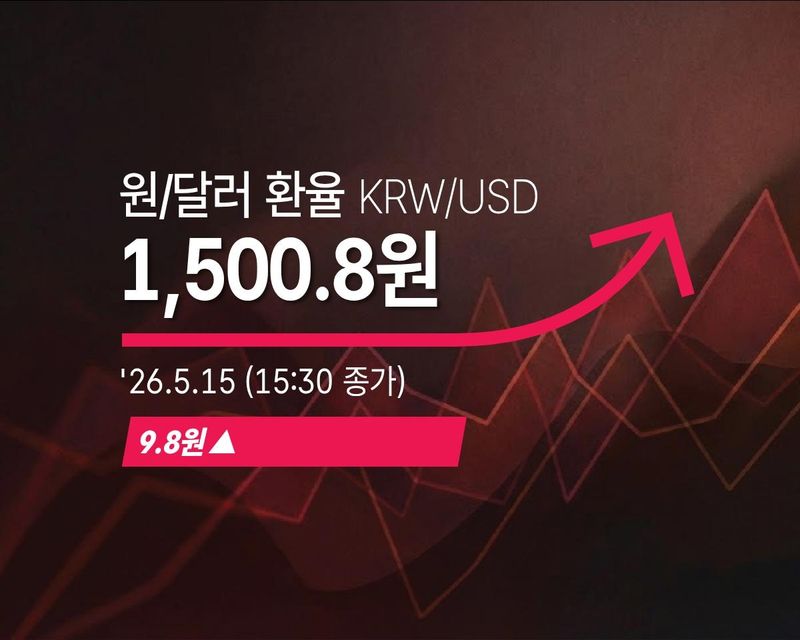
- KRW/USD Exchange Rate: Closed at 1,500.8 won (+9.8 won), having exceeded 1,500 won during the day
- Market Sentiment: Risk-aversion deepened due to the U.S. CPI shock and record-level foreign selling; individual and institutional investors tried to defend the market, but it wasn't enough.
Supply and Demand (KOSPI)
- Foreigners: Net sold approx. 5 trillion won, focusing on large-cap semiconductor stocks like Samsung Electronics and SK Hynix.
- Institutions: Helped defend the index with some net buying.
- Individuals: Absorbed some of the foreign sell-off through net buying.
Top 5 Key News
① U.S. April CPI beats expectations; global inflation fears reignite
- What happened?: The U.S. April CPI came in higher than market expectations. This cooled hopes for a Federal Reserve interest rate cut and reignited global dollar strength. The New York stock market saw mixed results, particularly in semiconductor stocks, putting downward pressure on the Korean market.
- Market Impact: Widespread weakness in semiconductor and AI-related stocks, downward pressure on the won.
② Foreigners sell for 5 consecutive sessions; over 24 trillion won withdrawn
- What happened?: Foreign investors have been net sellers for five straight days, pulling out over 24 trillion won cumulatively. On this day alone, they sold about 5 trillion won, targeting major semiconductor names like Samsung Electronics and SK Hynix. Conversely, they continued to net buy in certain sectors like robotics and power infrastructure.
- Market Impact: Threat to the KOSPI 7,500 line, sharp drop in Samsung Electronics.

③ Won-dollar exchange rate back above 1,500 won after one month
- What happened?: In the Seoul foreign exchange market, the rate closed at 1,500.8 won, up 9.8 won from the previous day. During the session, it topped 1,500 won, recovering the level for the first time in about a month since April 7. The Bank of Korea had noted that the rate dropped to the 1,450 range due to expectations of progress in U.S.-Iran peace talks and a stronger yen, but it surged again today.
- Market Impact: Increased pressure on import prices, concerns over further foreign capital flight.
④ Fear Index (VKOSPI) surges despite recent KOSPI highs
- What happened?: As the KOSPI has been hitting record highs, the "Korea Fear Index" (VKOSPI) has also been climbing. Market volatility has become extreme due to this month's historic foreign sell-off; analysts noted the volatility is at an all-time high, with the "sidecar" triggered 15 times this year alone.
- Market Impact: Weaker investor sentiment, warnings of short-term overheating.

⑤ "Direct buying" of Korean stocks remains a craze for overseas investors
- What happened?: As Korean semiconductor firms continue their upward momentum, overseas investors are sharing methods for investing directly in Korean stocks with great interest. Online communities abroad are spreading guides on direct investment, and some long-term foreign investors are sticking with the market, suggesting that "they won't escape" even after sell-offs.
- Market Impact: Possibility of maintaining a mid-to-long-term foreign demand base despite short-term profit-taking.
Leading Sectors & Themes
Semiconductors
- Trend: The sector took a nosedive due to the U.S. CPI shock and massive foreign selling. Samsung Electronics fell over 5%, and SK Hynix dropped around 1%. Foreigners have net sold over 4 trillion won in large-cap semiconductor stocks alone recently.
- Key Stocks: Samsung Electronics (-5%+), SK Hynix (~1%), Samsung Electro-Mechanics
Robotics & Physical AI (Theme)
- Trend: Foreigners shifted some of the funds pulled from semiconductors into the robotics and power infrastructure sectors. Hyundai Motor, Doosan Robotics, and Rainbow Robotics emerged as targets for foreign net buying.
- Key Stocks: Hyundai Motor, Doosan Robotics, Rainbow Robotics
Defense & Power Infrastructure (Theme)
- Trend: Amid the concentration in semiconductor and theme ETFs, defense and power infrastructure sectors held relatively strong. Concerns about over-concentration are being raised as various semiconductor, robot, and defense ETFs are launched.
- Key Stocks: Hanwha Aerospace, Doosan Enerbility
Top Gainers & Losers
Top 3 Gainers
- Rainbow Robotics — Up — Focus of foreign buying in robot/AI sectors; beneficiary of Physical AI theme.
- Doosan Robotics — Up — Inflow of foreign net buying after exit from semiconductors.
- Hanwha Aerospace — Up — Inclusion in defense theme ETFs and continued expectations for global defense demand.
Top 3 Losers
- Samsung Electronics — -5%+ — Massive foreign net selling; general semiconductor slump from U.S. CPI shock.
- SK Hynix — ~1% — Pressure from foreign profit-taking.
- Samsung Electro-Mechanics — Down — Parallel weakness in the semiconductor value chain.
Overseas Market Connections
① U.S. April CPI beats expectations → Dollar strength and downward pressure on KOSPI The U.S. April CPI exceeded expectations, leading to a retreat in Fed rate cut expectations and a stronger dollar, pushing the KRW/USD rate back above 1,500 won. Weakness in U.S. semiconductor stocks hit the Korean market directly.
② Correlation between foreign selling and rising exchange rates → The "Paradox" effect Usually, a strong stock market is accompanied by a stronger won (lower exchange rate). Recently, however, we are seeing a paradoxical situation where the KOSPI rises while the USD-KRW rate increases. Experts analyze that the nature of foreign selling has changed, incorporating portfolio restructuring rather than simple profit-taking.
Tomorrow's Checkpoints
- Fed statements and further inflation data: Watch for changes in rate cut expectations based on comments from Fed officials and upcoming data like PPI following the CPI shock.
- Foreign demand pivot: Monitor whether the 5-day net selling streak continues or reverses—specifically looking at the foreign sentiment toward large-cap semiconductor stocks (Samsung Electronics, SK Hynix).
- Exchange rate 1,500 won: Will it settle above 1,500 won, or will it pull back? If it settles, concerns over import inflation and further foreign exit will grow; if it drops, it could form a momentum for a market rebound.
Investor Action Items
- Check morning supply/demand: Watch whether foreign investors switch to net buying or selling within the first 10 minutes of the market opening to gauge the day's direction.
- Semiconductor vs. Robot/Defense rotation: Check sector flow data to see if the trend of moving funds from semiconductors into robotics/power/defense continues.
- Monitor the 1,500 won rate: Re-evaluate the earnings outlook for exporters (semiconductors/autos) and the risk of further foreign capital flight depending on the exchange rate level.
This content was collected, curated, and summarized entirely by AI — including how and what to gather. It may contain inaccuracies. Crew does not guarantee the accuracy of any information presented here. Always verify facts on your own before acting on them. Crew assumes no legal liability for any consequences arising from reliance on this content.
Powered by

