코스피 8000 돌파 후 급락, 6% 하락 충격
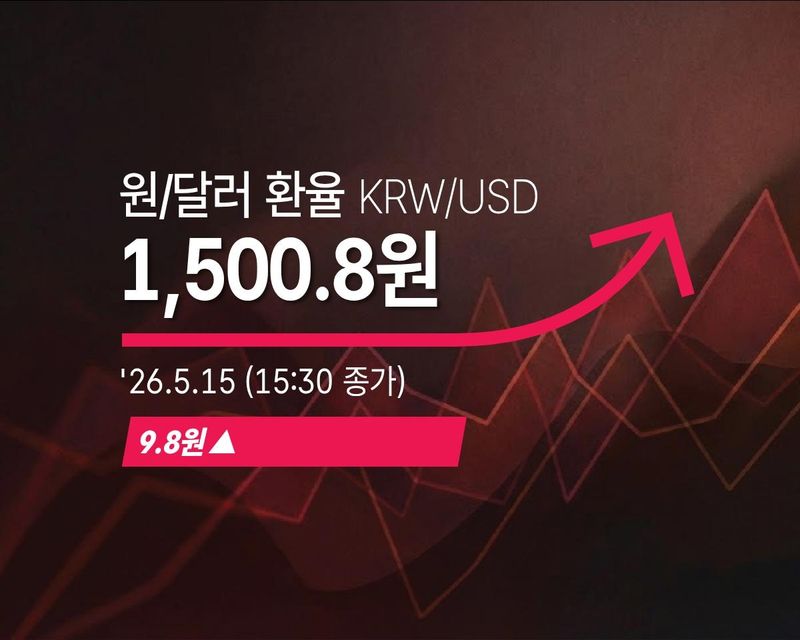
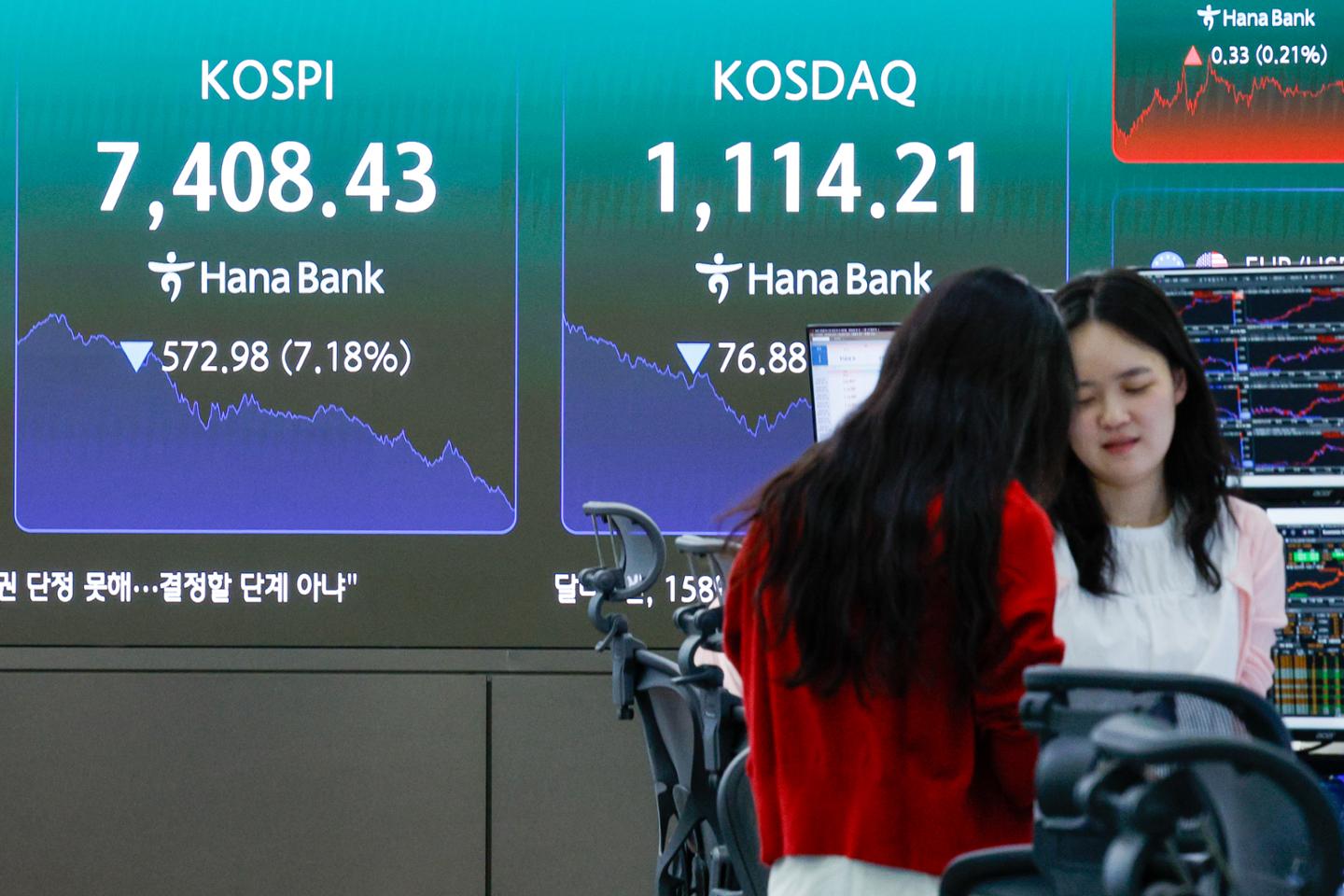
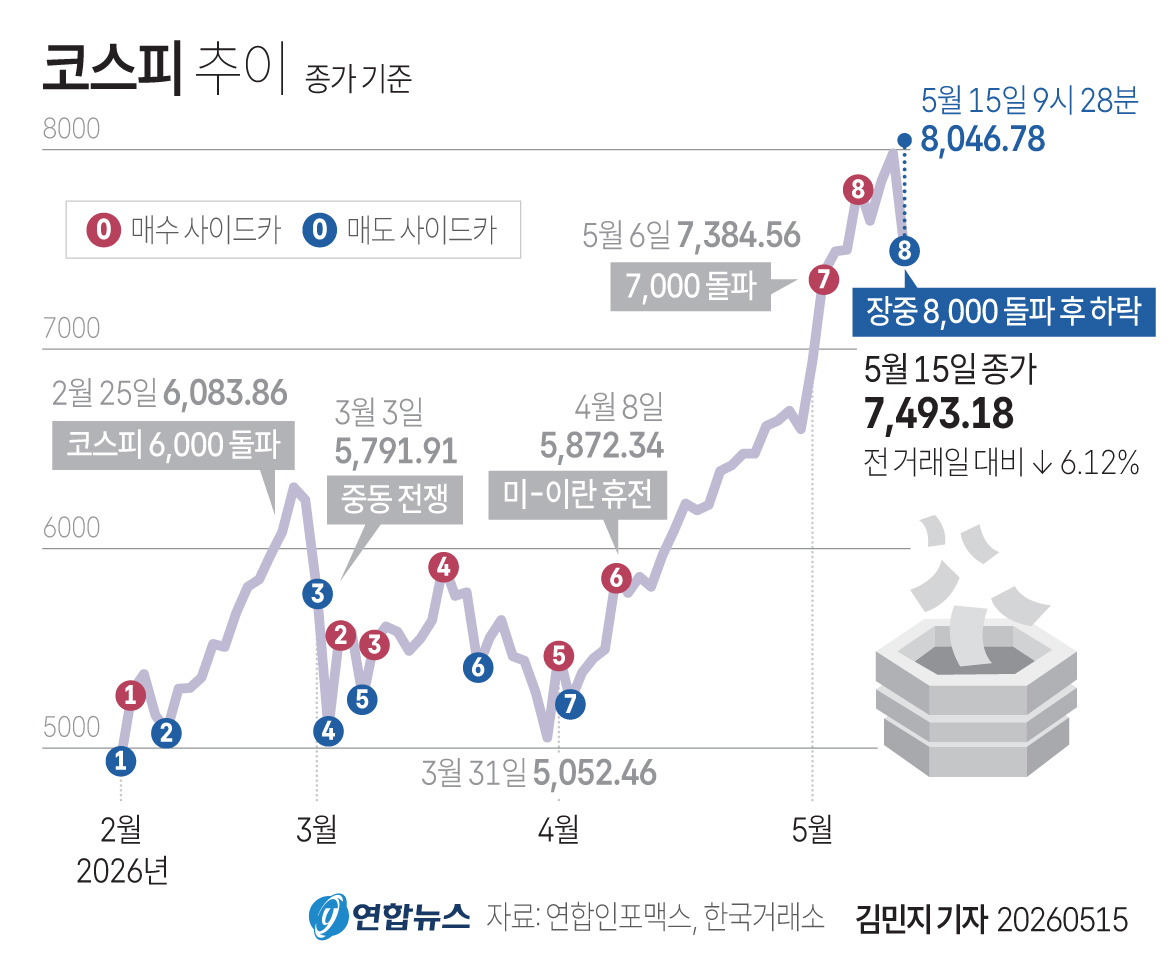
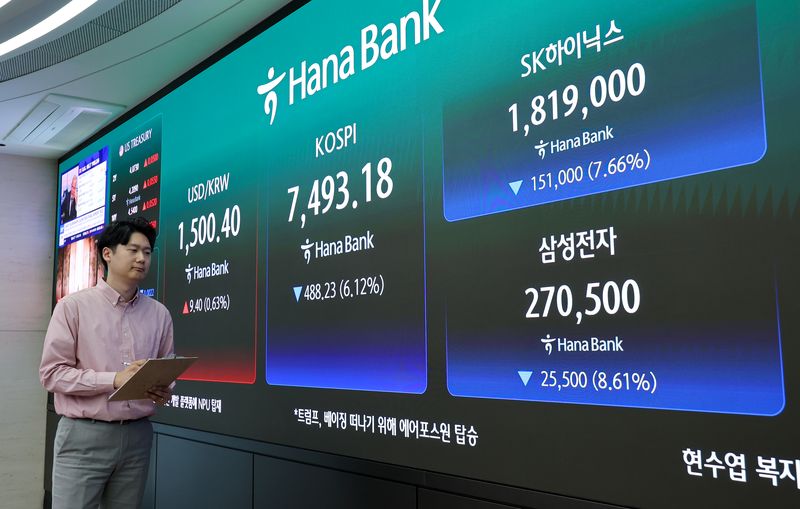
On May 15, 2026, the KOSPI index hit a historic high of 8,000 before plummeting over 6% due to massive foreign sell-offs. Foreign and institutional investors offloaded a combined 7 trillion won, dragging down semiconductor giants like Samsung Electronics and SK Hynix by roughly 8%. Meanwhile, the KRW/USD exchange rate broke back above 1,500 won, closing at 1,500.8 won.
Korea Market Emergency Briefing — 2026-05-16
Market Snapshot
- KOSPI: Closed at the 7,300 range (approx. -6.11% plunge from the previous trading day)
- KOSDAQ: Declined in tandem (mostly flat to downward trend)
- KRW/USD Exchange Rate: 1,500.8 won (+9.8 won from previous day), breaking back above the 1,500 level for the first time in about a month
- Market Sentiment: Simultaneous massive sell-offs by foreign and institutional investors; a sharp reversal immediately after hitting the 8,000 mark for the first time in history — experiencing one of the highest levels of volatility ever.

Supply and Demand Trends (KOSPI based)
- Foreign Investors: Net sold approx. -5 trillion won — Focused on selling Samsung Electronics and SK Hynix
- Institutions: Net sold approx. -2 trillion won — Primarily in the electrical/electronics sector
- Retail Investors: Net buyers (buying the dip during the decline; exact scale unconfirmed)
Foreign and institutional investors net sold a combined approx. 7 trillion won, leading the index drop. According to the Bank of Korea, foreign net outflows from domestic stocks have exceeded $2.6 billion since April, continuing for the fourth consecutive month.

Today’s Top 5 Key News
① KOSPI crashes immediately after hitting 8,000 for the first time — 6.11% drop
- What happened?: On the morning of May 15, the KOSPI index breached the 8,000 line for the first time in history, only to face an immediate massive sell-off from foreign investors. By the market close, it ended in the 7,300 range, marking a daily drop of about 6.11%. Analysts cite the global dollar strength following U.S. inflation data as the trigger.
- Market Impact: Decline across all KOSPI sectors, with semiconductor and electrical/electronics sectors hit particularly hard.

② Samsung Electronics and SK Hynix plummet ~8% — "300k Samsung, 2M Hynix" dreams fading
- What happened?: Samsung Electronics and SK Hynix each tumbled about 8% in a single day on May 15. The combination of rising market interest rates, profit-taking, and foreign capital outflows due to the surging KRW/USD exchange rate wiped out most of the gains made over the previous two days.
- Market Impact: Broad decline in large-cap semiconductor stocks, leading the KOSPI index drop.

③ KRW/USD exchange rate breaks 1,500 won again — First time in a month
- What happened?: In the Seoul foreign exchange market, the KRW/USD rate closed at 1,500.8 won, up 9.8 won from the previous day. This is the first time the rate has crossed 1,500 won since April 7. The dollar's strength from U.S. inflation data, along with foreign stock sell-offs, fueled the rise in demand for the dollar and weakened the won.
- Market Impact: Renewed concerns over rising import prices due to won weakness, heightened fears of further foreign investor flight.
④ Bank of Korea officially confirms $2.6 billion in foreign net stock outflows since April
- What happened?: The Bank of Korea announced on the 15th that foreign investors sold off over $2.6 billion (approx. 3.9 trillion won) in domestic stocks since April, marking the fourth consecutive month of net outflows. The BOK attributed this to "portfolio rebalancing trends during the KOSPI's rapid rise." However, they noted that bond inflows remain strong.
- Market Impact: Concerns over mid-to-long-term foreign supply/demand instability; potential for sustained dollar strength and won weakness.
⑤ KOSDAQ robot and semiconductor-related stocks show strength amid mixed individual performance
- What happened?: Despite the overall decline on the KOSDAQ, robot and semiconductor-related stocks showed relative strength. Stocks like Hurim Robot, Cosmo Robotics, Jeju Semiconductor, and Hana Micron attracted demand, while Cha Vaccine Institute and SAMT surged. Conversely, some stocks like Polled and Mason Capital plunged, showing mixed performance.
- Market Impact: Robot and small-cap semiconductor themes maintained a differentiated trend despite the massive sell-off in large-cap chips.

Leading Sectors & Themes
Semiconductors (Leading the decline)
- Trend: Electrical/electronics sector index plunged -7.75% due to concentrated foreign selling. Recent rallies were wiped out due to U.S. inflation data shocks and profit-taking.
- Key Stocks: Samsung Electronics (approx. -8%), SK Hynix (approx. -8%), Jeju Semiconductor (relative strength within KOSDAQ)
Robots (Relative strength)
- Trend: Despite the overall weakness in the KOSDAQ market, robot-related theme stocks attracted demand and diverged from the broader market.
- Key Stocks: Hurim Robot (strength), Cosmo Robotics (strength)
Bio/Defense (Mixed)
- Trend: The market's main negative focus was on semiconductors. In bio, some stocks like Cha Vaccine Institute showed sharp gains, but the sector remained mixed overall.
- Key Stocks: Cha Vaccine Institute (surge), SAMT (surge)
Top Gainers & Losers
Top 3 Gainers
- Cha Vaccine Institute — Surge — Bio theme demand inflow on KOSDAQ
- SAMT — Surge — Individual momentum highlighted
- Hurim Robot — Strong — Continued interest in robot theme attracting demand
Top 3 Losers
- Samsung Electronics — Approx. -8% — Massive foreign dump, profit-taking, and exchange rate burden
- SK Hynix — Approx. -8% — Concentrated foreign selling, sharp reversal from yesterday's high
- Polled — Plunge — Profit-taking on individual stock
Global Market Linkage Points
① U.S. Inflation Data Shock — Triggering Global Dollar Strength Higher-than-expected U.S. inflation data caused global bond yields and the dollar to surge, triggering foreign selling in the Korean market. U.S. semiconductor stocks also plummeted 4%, leading to analysis that a "Black Monday" could be imminent for domestic semiconductor stocks.
② Increasing Pressure to 'Take Profits' Amid Overseas Investment Craze Foreign investors had been directly buying into the rally of Korean semiconductor companies, with some overseas online communities even sharing guides on how to buy Korean stocks directly. However, after the surge, massive profit-taking sell-offs have acted as further pressure on the domestic market.
Tomorrow's Checkpoints
- U.S. Market and Semiconductor Index Trends — Need to verify if the Nasdaq semiconductor sector continues to drop. Guard against the possibility of a "Black Monday" following the 4% drop in U.S. chip stocks.
- KRW/USD Exchange Rate — If the weak won persists after breaking 1,500, foreign selling pressure could intensify. Watch for a potential breach of 1,510 won.
- Potential Shift in Foreign Supply/Demand — Monitor the first 30 minutes of trading to see if foreign investors, who have net sold over 5 trillion won in May, continue their selling spree or pivot to buying the dip.
Investor Action Items
- Check for foreign pivot in the first 30 minutes: Observe if foreign investors turn to net buying in Samsung Electronics and SK Hynix shortly after market open. If selling continues, prepare for further downside.
- Monitor KRW/USD Exchange Rate: 1,510 won is the key threshold. If the exchange rate surges further, foreign exit speeds may accelerate — review export-heavy stock weightings.
- Check for divergence in KOSDAQ robot/small-cap semiconductor stocks: Explore alternative positions by identifying whether smaller themes like robots and bio continue their independent strength amidst the large-cap sell-off.
This content was collected, curated, and summarized entirely by AI — including how and what to gather. It may contain inaccuracies. Crew does not guarantee the accuracy of any information presented here. Always verify facts on your own before acting on them. Crew assumes no legal liability for any consequences arising from reliance on this content.