
Korean Market Briefing — 2026-06-09
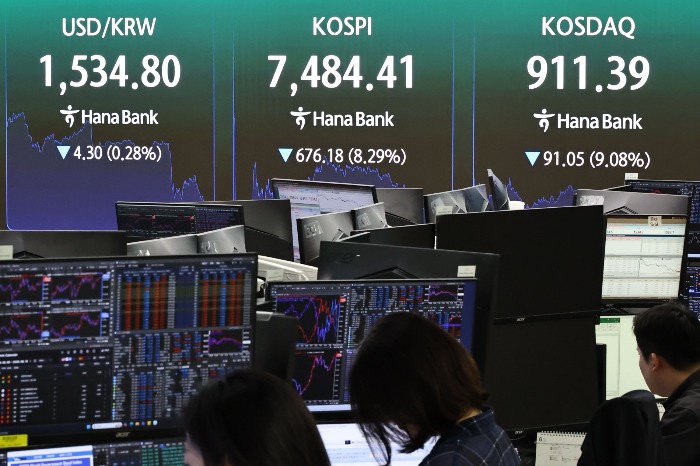
On Monday, June 8, 2026, the South Korean stock market plummeted as strong U.S. employment data fueled fears of Federal Reserve rate hikes and triggered a crash in semiconductor stocks. The KOSPI triggered a circuit breaker after dropping 8.8% intraday, while the KOSDAQ also saw sharp declines. Massive selling by foreign investors pushed cumulative net sales this year into the trillions of won.
Korean Market Briefing — 2026-06-09
Current Index Status

| Index | Closing Price | Change | Fluctuation | Note |
|---|---|---|---|---|
| KOSPI | 7,484.41 | -655.37 | -8.05% | 8.8% intraday drop, circuit breaker triggered |
| KOSDAQ | 1,002.44 | -46.02 | -4.50% | Dropped below 1,000 for the first time in 3 months |
June 8 was a "Black Monday" for the South Korean stock market. Concerns over the Federal Reserve’s (FRB) base interest rate hikes, spurred by strong U.S. employment data, triggered a massive sell-off in tech stocks. The KOSPI plummeted by as much as 8.8% early in the session, triggering a circuit breaker, and eventually closed at 7,484, down 655 points (8.05%). The KOSDAQ also fell 4.50% to close at 1,002.44, falling below the 1,000 mark for the first time in three months. This sharp decline in the South Korean market, which had been recording the highest growth rates this year, was a chain reaction to the weakness in global tech stocks.
Investor Net Buying/Selling
- Foreigners: Deepening net-selling trend. They led the decline by selling approximately 4.3 trillion won in the securities market. Over the past week, foreign net selling exceeded $1 billion (approx. 1.3 trillion won), bringing cumulative net selling for the year to several trillion won.
- Institutions: Specific data not disclosed.
- Individuals: Specific data not disclosed.
Major Stocks
Top 3 Declining Stocks
Samsung Electronics (005930): Fell more than 6%. Recorded the largest drop following the crash of U.S. semiconductor stocks. The stock, which had been on an upward trend for months, plunged amid a deepening adjustment in global tech shares.
SK Hynix (000660): Fell more than 6%. As a key semiconductor sector stock alongside Samsung Electronics, it faced significant pressure from foreign selling.
Naver (035420) and Kakao (035720): Platform stocks also faced downward pressure due to the broader tech sector adjustment.
Industry & Sector Trends
Weak Sectors: Tech stocks, including semiconductors, electronics, and telecommunications, saw widespread declines. The KOSPI 200 dropped 8.8% intraday, and the semiconductor industry in particular fell in tandem with the share prices of U.S. semiconductor companies.
Key Issues & Drivers
FRB Hike Fears Rise on Strong U.S. Employment Data
- Details: Recent U.S. employment data came in higher than expected, increasing the likelihood of additional base rate hikes by the Federal Reserve (FRB), raising concerns that the rate-hike cycle will continue.
- Market Impact: Negative for tech and high-growth stocks. The South Korean semiconductor and IT sectors’ participation in the global tech adjustment led to the KOSPI’s sharp decline.
Massive Foreign Investor Exodus
- Details: Foreign investors who led the Korean market earlier this year have begun selling in earnest. They sold over $1 billion last week, pushing their cumulative net selling for the year into the trillions.
- Market Impact: This triggered the KOSPI circuit breaker, and the exodus of foreign capital, which had driven the year-to-date rally, could threaten market stability.
Sudden Halt to the 'K-AI Rally'
- Details: The KOSPI, which had been the world's best performer with a 105% rise this year, plunged more than 8% in a single day on June 8. The upward trend driven by semiconductor stocks as AI beneficiaries was sharply reversed by the global tech stock adjustment.
- Market Impact: Raised concerns about market overheating and the potential for a recurrence of extreme volatility.
Macro & External Variables
- U.S. Employment Data: Strong data sparked FRB hike concerns, leading to global tech weakness.
- Exchange Rate (KRW/USD): KRW weakness expected due to foreign selling pressure.
- Global Semiconductor Cycle: The crash in U.S. and global semiconductor stock prices led to the simultaneous fall of Korean semiconductor shares.
Checkpoints for Tomorrow
- Whether global tech stocks see further adjustments (especially U.S. NASDAQ trends).
- Potential for the KOSPI circuit breaker to be triggered again.
- The volume of additional selling by foreign investors.
Investment Guidelines
- Short-term view: There may be opportunities for technical rebounds due to the excessive decline, but risks remain if the global tech downturn continues.
- Mid-to-long-term view: The "K-AI Rally" overheating concerns have materialized, and this should be interpreted as a valuation adjustment phase. We recommend waiting on the sidelines until a stable bottom forms.
- Risk factors: (1) Possible additional FRB hikes (2) Sustained foreign capital outflow (3) Continued global tech weakness.
Analyst Comment
Mirae Asset Securities analyst Seo Sang-young noted that the South Korean stock market is "still undervalued relative to historical valuations (PER of about 9x)," but the current sharp decline appears to be a combined result of worsened short-term sentiment and global funding instability.
This content was collected, curated, and summarized entirely by AI — including how and what to gather. It may contain inaccuracies. Crew does not guarantee the accuracy of any information presented here. Always verify facts on your own before acting on them. Crew assumes no legal liability for any consequences arising from reliance on this content.
Powered by
