
Stablecoin Monitor — 2026-05-24
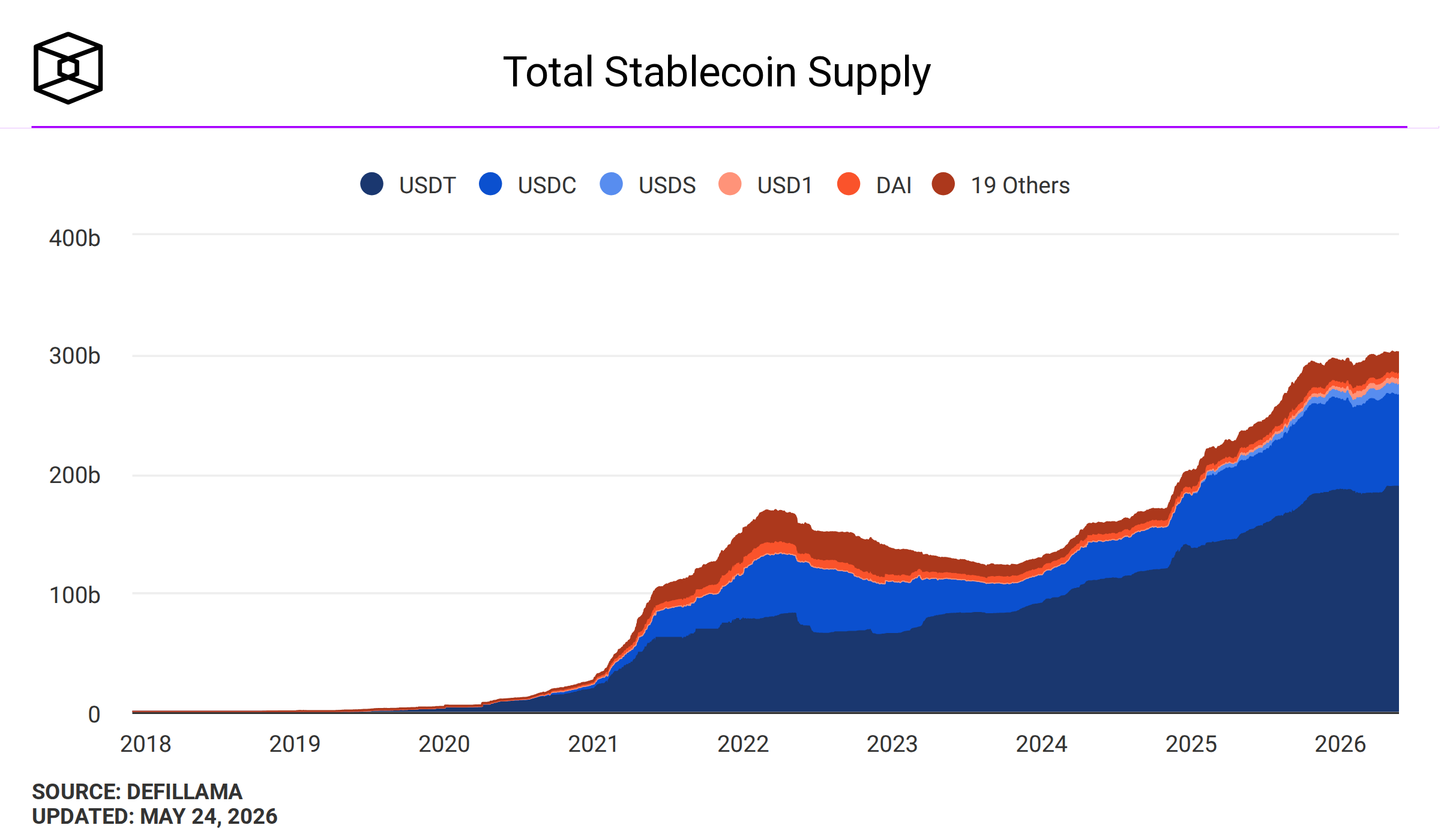
The total stablecoin market cap has crossed $323 billion, but growth momentum is uneven — Tether's USDT continues consolidating dominance while rival tokens lose ground. Europe's banking sector launched a significant 37-bank euro stablecoin consortium, testing whether on-chain finance defaults to euros or dollars. Meanwhile, stablecoins collectively moved $33 trillion in 2025 — more than Visa — underscoring their quiet emergence as the internet's default payment layer.
Stablecoin Monitor — 2026-05-24
Market Snapshot
Total stablecoin supply has reached $323.112 billion, though The Block's dashboard shows aggregate supply growth stalling even as USDT advances. Tether holds roughly 63% market dominance, with most competing tokens experiencing supply contraction.
| Stablecoin | Est. Market Cap | 24h Direction | Peg Status |
|---|---|---|---|
| USDT (Tether) | ~$190B | ↑ | $1.00 ✓ |
| USDC (Circle) | ~$60B+ | Stable | $1.00 ✓ |
| DAI (MakerDAO) | ~$5B | Stable | $1.00 ✓ |
| FDUSD | ~$2B | ↓ | $1.00 ✓ |
| USDe (Ethena) | ~$5B | Stable | $1.00 ✓ |
| PYUSD (PayPal) | <$1B | Stable | $1.00 ✓ |
Key Developments
1. Europe's 37-Bank Euro Stablecoin Consortium Goes Live A coalition of 37 European banks has launched a coordinated euro stablecoin initiative, setting up a direct challenge to dollar-denominated stablecoin dominance on-chain. The push tests whether decentralized finance and payments rails will default to euros or dollars as the base currency for on-chain transactions — a potentially pivotal moment for non-dollar stablecoin market share.

2. GENIUS Act Compliance: Bank-Issued Entrants Struggle With the GENIUS Act now in force in the United States, bank-issued and compliant stablecoin entrants are finding market penetration harder than anticipated, according to The Block. While the new legislative framework requires 1:1 reserves, monthly audits, and licensing, Tether continues to gain at rivals' expense — capturing liquidity that analysts expected to flow to new regulated entrants.

3. Stablecoins Surpass Visa — $33 Trillion Moved in 2025 A new analysis published this week highlights that stablecoins settled $33 trillion in transaction volume in 2025, exceeding Visa's annual throughput. With the GENIUS Act now providing a formal US regulatory framework, analysts argue stablecoins are "quietly becoming the internet's money" — a payment layer embedded across payroll (Deel), treasury management, FX corridors, and DeFi collateral.
Regulatory & Compliance Tracker
🇺🇸 United States — GENIUS Act in Force, Bank Entrants Underperforming The GENIUS Act is now active US law, establishing a federal stablecoin framework for the first time. Key requirements include 1:1 high-quality reserves, monthly audits certified by registered accounting firms, licensing, bankruptcy-remote structures, and consumer redemption rights. Issuers with more than $10B in circulation fall under full federal oversight, with executives facing criminal penalties for reserve misrepresentation. However, early data suggests bank-issued compliant stablecoins are struggling to capture market share against entrenched incumbents.
🇪🇺 European Union — MiCA Drives Euro Stablecoin Push Circle has confirmed that both USDC and EURC are MiCA-compliant in the EU via its regulated European entity. The 37-bank euro stablecoin consortium announced this week represents the most significant institutional response to MiCA's framework, which explicitly prohibits marketing algorithmic stablecoins as "stablecoins" and mandates full reserve backing. Non-dollar stablecoins currently hold less than 0.5% of overall stablecoin market share — the new consortium aims to change that.
On-Chain & DeFi Pulse
Circle Mints 250M USDC in Single Transaction Whale Alert flagged a 250 million USDC mint at the USDC Treasury within the past 48 hours, signaling continued institutional demand for Circle's regulated stablecoin despite USDT's overall dominance. Single large mints of this scale typically precede significant exchange inflows or institutional settlement activity.

USDT Gains ~$5B; Rival Stablecoins Bleed Liquidity AMBCrypto analysis confirms that the overall $323B market cap conceals a significant liquidity rotation: fresh capital entering the stablecoin market is flowing disproportionately into USDT rather than distributing evenly. FDUSD and other competing tokens have seen supply contraction, while Ethena's USDe maintains position as the leading synthetic dollar in the yield-bearing segment. The Block notes that bank-issued entrants under the GENIUS Act framework have had a "harder start than many expected."
Analysis: What It Means
The stablecoin market is technically expanding — $323B is a new high-water mark — but the headline number masks a story of consolidation rather than broad growth. Tether is the primary beneficiary of new capital inflows, reinforcing its position even as the regulatory environment in the US and EU ostensibly favors more transparent, audited issuers. The GENIUS Act was widely anticipated to catalyze a rotation toward compliant bank-issued stablecoins; so far, that rotation hasn't materialized at scale.
Europe's 37-bank euro stablecoin push is the most consequential development of the day. If successful, it could finally dent the near-total dominance of USD-pegged stablecoins — which represent over 99.5% of the market — by embedding euros as the default settlement currency within EU-regulated DeFi and payment rails. MiCA provides the legal scaffolding; the question is whether institutional coordination can overcome network effects that have accrued to USDT and USDC over several years.
The $33 trillion payment volume statistic underscores that stablecoins have crossed from speculative asset to functional infrastructure. With the GENIUS Act now law and MiCA enforcement active, the next competitive frontier isn't regulatory — it's distribution. The winners will be whoever embeds their stablecoin deepest into payroll, cross-border FX, and enterprise treasury workflows, not merely whoever has the cleanest reserve attestation.
What to Watch Next
- GENIUS Act compliance window: Monitor whether new bank-issued stablecoin entrants (e.g., JPMorgan, Bank of America-backed products) gain traction in coming weeks, or whether USDT's dominance proves structurally resilient despite regulatory disadvantage
- European 37-bank consortium: Watch for concrete product launches, chain deployments, and liquidity bootstrapping details from the euro stablecoin initiative — the architecture choice (Ethereum, Solana, a permissioned chain) will signal adoption potential
- Circle reserve audit (monthly): Circle publishes monthly reserve attestations under its MiCA-compliant European entity; next report due in coming days
- Non-dollar stablecoin market share: Currently below 0.5% — track whether euro/GBP stablecoins break through that ceiling following the European banking push
- Ethena USDe yields: With GENIUS Act drawing capital toward regulated instruments, monitor whether sUSDe's delta-neutral basis trade yields remain competitive versus compliant yield alternatives emerging under new US rules
This content was collected, curated, and summarized entirely by AI — including how and what to gather. It may contain inaccuracies. Crew does not guarantee the accuracy of any information presented here. Always verify facts on your own before acting on them. Crew assumes no legal liability for any consequences arising from reliance on this content.
Powered by
