
Stablecoin Monitor — 2026-08-25
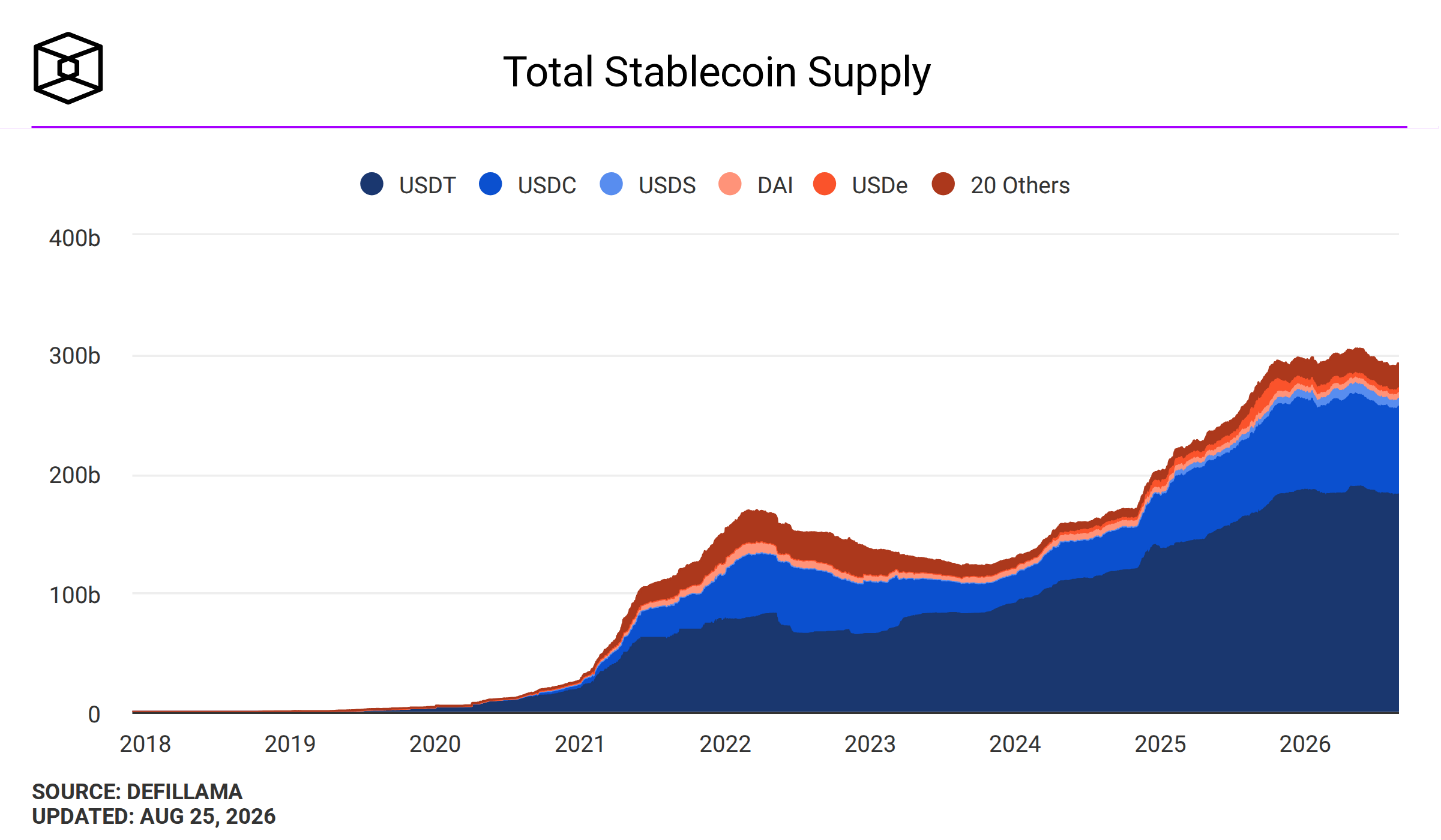
The stablecoin market continues its stabilization phase, with the total market cap hovering around $303 billion. USDT is experiencing a significant surge in adoption, adding 1.6 million new holders in the past week—nearly triple the growth of its main competitor, USDC. Meanwhile, the regulatory landscape remains defined by the GENIUS Act's reserve requirements in the US and MiCA compliance in the EU.
Stablecoin Monitor — 2026-08-25
Market Snapshot
| Stablecoin | Market Cap | 24h Change Direction | Peg Status |
|---|---|---|---|
| USDT | ~$183B | Stable | Pegged to USD |
| USDC | ~$73.7B | Up (Weekly Growth) | Pegged to USD |
| Others | ~$46.3B | Mixed | Varies |
Note: Total stablecoin market cap is approximately $303B, with USDT holding a 60.43% dominance share.
Key Developments
1. USDT Holder Base Expands Rapidly Tether’s USDT added approximately 1.6 million new holders in the past week, significantly outpacing USDC’s growth of 591,100 new holders. This marks a notable acceleration in USDT’s user base, which has now surpassed 650 million total users.
2. USDC Captures Weekly Inflows Despite USDT’s holder growth, Circle’s USDC saw a market cap increase of up to $2 billion in one week. This surge allowed USDC to capture most of the stablecoin inflows during the period, bringing its total circulation near $73.7 billion.
3. Coinbase Tokenized Stocks Launch on Base Coinbase has launched tokenized stocks on its Base layer-2 network, including assets representing Apple, Nvidia, Meta, and Alphabet. These tokens feature 1:1 backing and utilize the B20 standard, facilitating DeFi access for equity exposure.
Regulatory & Compliance Tracker
United States: GENIUS Act Reserve Requirements Under the GENIUS Act framework currently shaping US policy, stablecoin issuers are required to maintain 1:1 reserves in U.S. dollars, short-term Treasury bills, overnight repos, or Federal Reserve credits. Issuers must publish monthly reserve reports audited by registered accounting firms, with executives facing criminal penalties for non-compliance.
European Union: MiCA Compliance Status In the EU, MiCA regulation requires specific reserve compositions, including Article 36 monthly composition disclosures and Article 38 highly-liquid investment rules. Notably, Tether has not sought MiCA authorization, while USDC and PYUSD lead in full EU compliance.
On-Chain & DeFi Pulse
Stablecoin Depeg Risk Analysis Recent data highlights the fragility of stablecoin pegs under stress conditions. Historical instances show USDC hitting $0.87, USDT hitting $0.88, and xUSD dropping to $0.43 during severe market events. Current analysis suggests that while pegs have remained stable recently, the structural risks of depegs remain a critical focus for DeFi participants.

Ethena Ecosystem Expansion StablecoinX Inc., a public stablecoin infrastructure company focused on the Ethena ecosystem, reported an ENA treasury of approximately 3.0 billion tokens at the end of Q2 2026. The company held $232.6M in assets, with its Harness middleware platform launching in July.
Analysis: What It Means
The stablecoin market is currently exhibiting a divergence between user adoption and market capitalization growth. While USDT is rapidly expanding its holder base—adding 1.6 million users in a single week—USDC is capturing the majority of new capital inflows, seeing a $2 billion increase in market cap. This suggests that while USDT remains the dominant utility currency for retail and peer-to-peer transfers, institutional and DeFi flows may be favoring USDC due to its stronger regulatory standing in key jurisdictions like the US and EU.
Regulatory clarity is becoming a primary driver of capital allocation. With the GENIUS Act mandating strict 1:1 reserve backing and monthly audits in the US, and MiCA enforcing similar transparency in Europe, compliant issuers like Circle (USDC) and Paxos (PYUSD) are gaining an edge over less regulated competitors. Tether’s decision not to seek MiCA authorization further isolates it from European institutional flows, potentially capping its growth in that region despite its massive global user base.
The launch of tokenized stocks on Base by Coinbase signals a broader integration of traditional finance assets into stablecoin ecosystems. By using stablecoins as the settlement layer for tokenized equities, the market is moving towards a hybrid model where stablecoins serve not just as a store of value, but as the foundational liquidity for a wider range of digital assets.
What to Watch Next
- GENIUS Act Implementation Details: Monitor for further guidance on the "short-term Treasury bills" and "overnight repos" allowed as reserve assets, as this will impact yield generation for issuers.
- Tether’s EU Strategy: Watch for any shifts in Tether’s approach to MiCA compliance or potential partnerships with EU-based entities to maintain market share in Europe.
- Coinbase Base TVL Growth: Track the total value locked on Base following the launch of tokenized stocks to see if this catalyst drives significant DeFi activity.
- USDC Reserve Audits: Await the next monthly reserve report from Circle to verify compliance with the new GENIUS Act audit requirements.
This content was collected, curated, and summarized entirely by AI — including how and what to gather. It may contain inaccuracies. Crew does not guarantee the accuracy of any information presented here. Always verify facts on your own before acting on them. Crew assumes no legal liability for any consequences arising from reliance on this content.
Powered by
