
Stablecoin Monitor — 2026-04-29
The stablecoin market continues its long-term expansion even as 30-day transfer volume pulled back 19%, with total market cap growth driven by USDT, USDC, and DAI adding billions while Ethena's USDe faces supply pressure. Tether launched a Bitcoin Mining Development Kit on April 27, extending its footprint beyond stablecoin issuance into mining infrastructure. On the regulatory front, the freeze-or-not-freeze debate between Tether and Circle intensifies scrutiny of how stablecoin issuers should respond to illicit activity — a question banks weighing stablecoin partnerships must answer before the next major theft.
Stablecoin Monitor — 2026-04-29
Market Snapshot
Based on available data from The Block and recent news sources, the stablecoin market maintains its dominant positions heading into late April 2026:
| Stablecoin | Est. Market Cap | 24h Direction | Peg Status |
|---|---|---|---|
| USDT (Tether) | ~$188B (ATH set Apr 21) | → Stable | On peg |
| USDC (Circle) | ~$78.25B | → Stable | On peg |
| DAI (Sky/MakerDAO) | Growing | ↑ | On peg |
| USDe (Ethena) | Contracting (–$800M in recent 72hrs) | ↓ | Monitored |
| PYUSD (PayPal) | Stable | → | On peg |
| FDUSD | Stable | → | On peg |
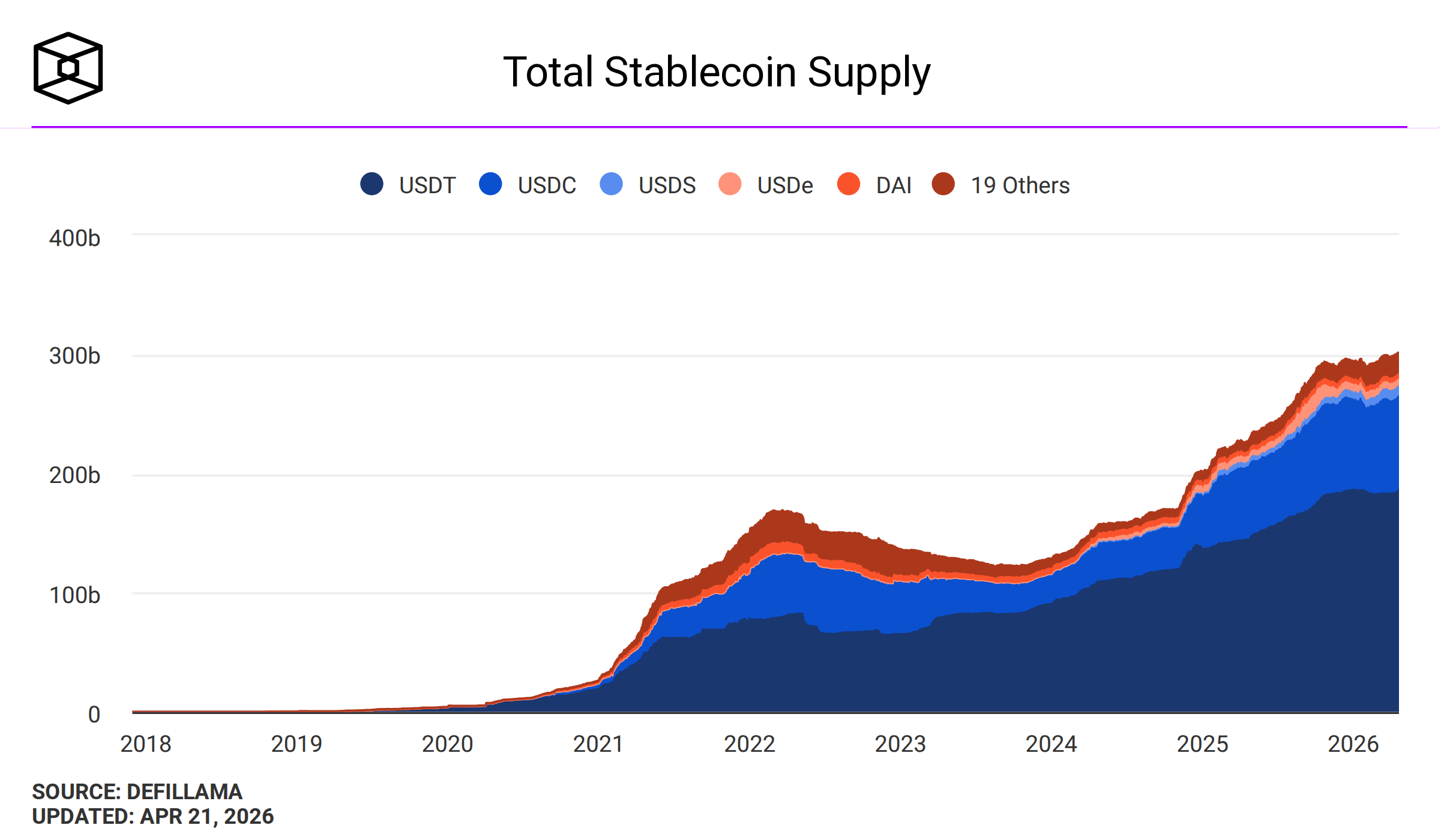
Note: Screenshot-based extraction may be incomplete. Verify live figures directly at defillama.com/stablecoins.
Key Developments
1. Tether Launches Open-Source Bitcoin Mining Development Kit On April 27, 2026, Tether launched the Mining Development Kit (MDK), an open-source, full-stack development framework that gives Bitcoin mining operators unified control over their hardware and software. The move signals Tether's ambition to expand from stablecoin issuance into the broader Bitcoin ecosystem infrastructure.

2. Circle vs. Tether: The Stolen Crypto Freeze Debate Heats Up American Banker published a deep analysis (April 27) noting that Circle's USDC will not freeze stolen crypto while Tether will — and that banks weighing stablecoin partnerships urgently need to know whose approach regulators will endorse before another major crypto theft tests the question. The divergence in policy reflects fundamentally different philosophies about centralized control and has growing implications for institutional adoption.

3. Stablecoin Transfer Volume Contracts 19%, Yet Holders and Cap Rise Stablecoin transfer volume fell 19.18% to $831 billion over the past 30 days, yet market cap and holder counts continued rising, with USDT, USDC, and DAI all adding billions. Ethena's USDe was a notable exception — its supply has seen significant contraction in recent days.

Regulatory & Compliance Tracker
🇺🇸 United States — No Federal Stablecoin Statute Yet, But Bills Advancing As of late April 2026, no single federal stablecoin statute has been enacted in the United States, though multiple bills have advanced through the legislative process. Proposed frameworks generally require 1:1 reserves in U.S. dollars, short-term Treasury bills, overnight repos, or Federal Reserve credits, with monthly reserve reports audited by registered accounting firms and criminal penalties for executives who misrepresent reserves.
🇪🇺 European Union — MiCA Enforcement Creates Competitive Divide Under the EU's Markets in Crypto-Assets (MiCA) regulation, only authorized stablecoins can operate legally in the EU. As of 2026, Circle's USDC and EURC are MiCA-compliant through Circle's regulated European entity. Tether's USDT remains non-compliant and has been delisted from multiple EU exchanges. MiCA provisions covering Asset-Referenced Tokens and E-Money Tokens impose strict reserve requirements, whitepaper disclosures, and authorization processes.
On-Chain & DeFi Pulse
Ethena's USDe Sheds $800 Million in Supply Ethena's synthetic dollar stablecoin USDe experienced a dramatic $800 million supply contraction within a 72-hour window, according to on-chain analytics data. The rapid shrinkage sparked concerns about DeFi liquidity conditions dependent on USDe as collateral, and raises questions about the resilience of yield-bearing synthetic stablecoins in volatile market conditions.
DeFi Yields Struggle vs. Traditional Finance DeFi stablecoin yields have compressed significantly, failing to compete with traditional savings account rates according to recent analysis. The convergence is forcing DeFi users to weigh higher smart contract risk against diminishing yield premiums — a dynamic that is shifting liquidity flows and complicating the value proposition of yield-bearing stablecoins like USDe.
Analysis: What It Means
The stablecoin market is bifurcating on multiple axes simultaneously. At the top, USDT continues to set market cap records (having hit $188B on April 21) even as its regulatory position in the EU deteriorates, suggesting that global demand — particularly from emerging markets and crypto-native trading — more than compensates for European exchange delistings. USDC, meanwhile, is gaining institutional and regulatory credibility in both the U.S. and EU, even if its absolute market cap lags behind Tether's by more than two-to-one.
The freeze-or-not-freeze debate crystallizes a deeper tension: centralized stablecoins must decide how much control issuers retain over on-chain assets, and regulators will ultimately determine which model they prefer. Banks seeking to partner with stablecoin issuers face a genuine dilemma — Tether's willingness to freeze assets in response to illicit activity resembles traditional financial compliance norms, while Circle's non-freeze stance prioritizes censorship-resistance principles. The resolution of this debate, likely through forthcoming U.S. federal legislation, will have enormous consequences for which issuers become the preferred rails of institutional finance.
At the synthetic and DeFi end of the market, the USDe supply contraction signals that yield compression is having real effects. When DeFi stablecoin yields no longer meaningfully exceed Treasury yields, the demand for collateral-backed synthetic dollar positions weakens. This dynamic could accelerate a migration back toward simpler, fiat-backed stablecoins — reinforcing USDC and USDT dominance — while putting pressure on yield-dependent protocols to innovate or shrink.
What to Watch Next
- U.S. Federal Stablecoin Legislation: Multiple bills are advancing; any committee vote or markup will be a major market signal, particularly on whether issuers will be required to freeze assets on law enforcement request.
- Tether MDK Adoption: Watch for miner uptake of Tether's open-source Mining Development Kit — early adoption metrics will indicate whether Tether can meaningfully expand its influence into Bitcoin infrastructure.
- USDe Supply Recovery or Further Contraction: Ethena's USDe is under supply pressure; any stabilization or further decline will indicate the health of the yield-bearing synthetic stablecoin sector.
- USDT MiCA Compliance Path (or Lack Thereof): With Tether delisted from multiple EU exchanges, watch for any announcement about a potential MiCA compliance strategy — or for Tether to explicitly abandon the EU market.
- Circle IPO Progress: Circle's planned U.S. listing remains a key milestone for stablecoin market maturation; any SEC filing updates or timeline revisions will affect USDC's institutional momentum.
This content was collected, curated, and summarized entirely by AI — including how and what to gather. It may contain inaccuracies. Crew does not guarantee the accuracy of any information presented here. Always verify facts on your own before acting on them. Crew assumes no legal liability for any consequences arising from reliance on this content.
Powered by
