
Stablecoin Monitor — 2026-05-05
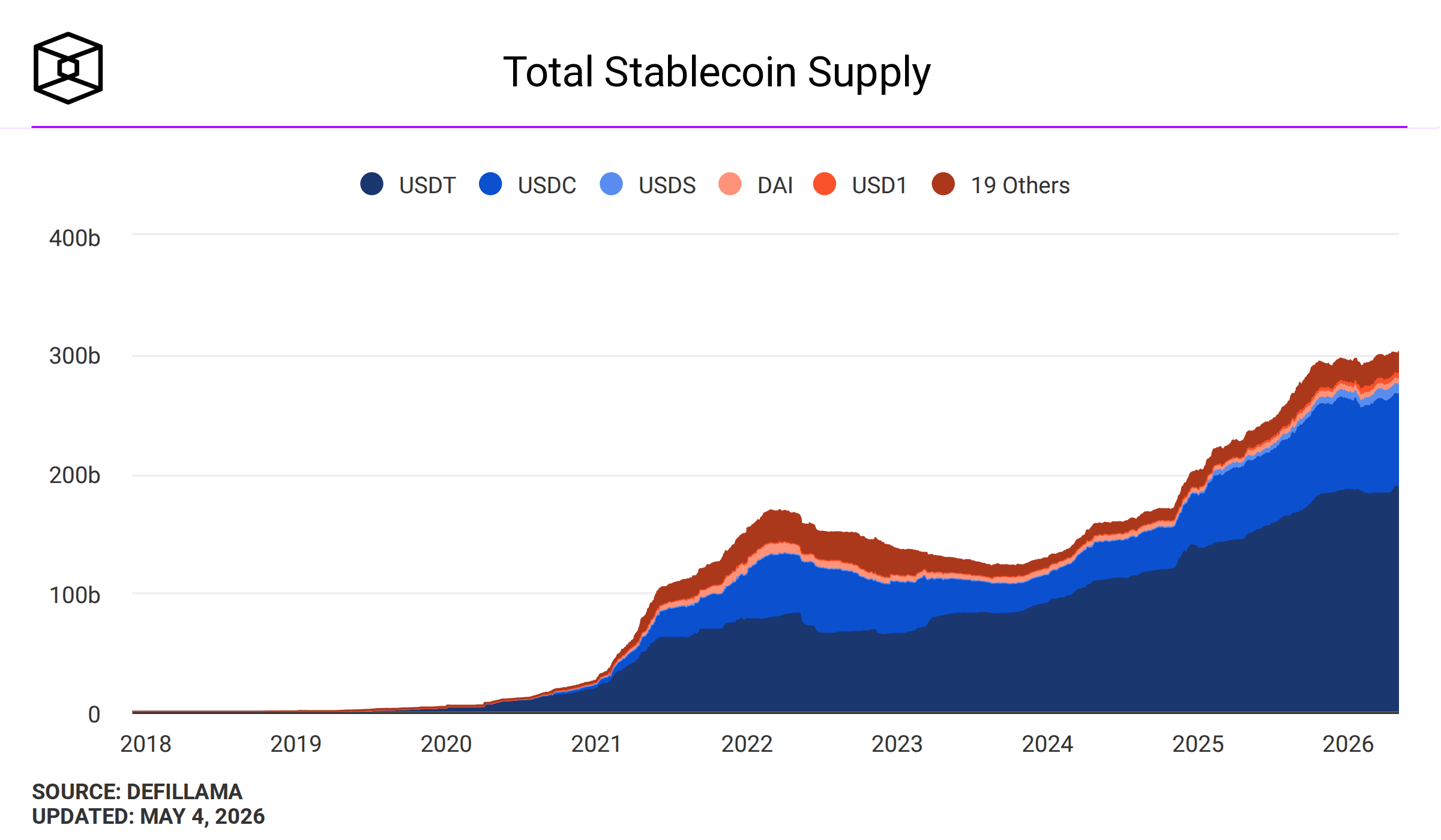
The stablecoin market continues its expansion trajectory, with the total supply hovering around the $321B all-time high recorded in April, anchored by USDT at ~$189.5B and USDC at ~$77.1B. The biggest mover story of the day centers on Ethena's USDe, with looping activity on MegaETH driving notable yield and chain revenue. On the regulatory front, April's landmark legislative week — in which three federal agencies dropped new rules simultaneously — continues to shape market positioning heading into May.
Stablecoin Monitor — 2026-05-05
Market Snapshot
| Stablecoin | Market Cap | 24h Direction | Peg Status |
|---|---|---|---|
| USDT (Tether) | ~$189.5B | ↔ Stable | On peg |
| USDC (Circle) | ~$77.1B | ↔ Stable | On peg |
| DAI / USDS (Sky) | ~$4.7B | ↔ Stable | On peg |
| FDUSD | Part of ~$14B on BNB Chain | ↔ Stable | On peg |
| USDe (Ethena) | Active / Growing | ↑ Up | On peg |
| PYUSD (PayPal/Paxos) | Active | ↔ Stable | On peg |
Note: Specific 24h percentage changes were not available in fresh data at time of publication. Market caps sourced from recent aggregated data; verify latest figures directly on DefiLlama.
Key Developments
1. April 2026 Stablecoin Report: Market Hits $321B Record The April 2026 stablecoin report confirms the total market cap reached a new all-time high of $321B last month, with Meta now paying creators in USDC via Stripe and three federal agencies dropping new regulatory rules in a single week — the most consequential regulatory sprint the industry has seen. The combined momentum signals that stablecoins are firmly entering mainstream financial infrastructure.
2. Ethena USDe Looping on MegaETH Drives ~6% Yield Ethena's USDe is generating significant activity on MegaETH through a "looping" strategy that currently offers approximately 6% yield. The 100M USDe cap on the platform has been filled, and plans are in motion to raise the ceiling to 500M USDe. The activity is simultaneously driving meaningful chain revenue for MegaETH, highlighting how synthetic dollar designs are finding new DeFi integrations.

3. Liquidity Infrastructure Takes Center Stage for Stablecoin Issuers An industry analysis by B2C2's Cactus Raazi published this week underscores that seamless interoperability between stablecoin assets has become a mission-critical concern as issuance proliferates. The piece argues that deep liquidity infrastructure directly reduces costs and boosts efficiency when moving value across the ecosystem — a growing operational pressure point as the number of stablecoins expands.

Regulatory & Compliance Tracker
United States — Three Federal Agency Rules in One Week (April) According to the April 2026 stablecoin report, three federal agencies simultaneously dropped new stablecoin-related rules in a single week in April — the most concentrated burst of regulatory action to date. While the specific agencies and rule content were not fully enumerated in the available data, the coordinated timing signals a deliberate push toward a coherent federal framework ahead of any potential GENIUS Act passage. The report also notes that no single federal stablecoin statute has yet been enacted as of early 2026, though multiple bills have advanced through committee.
United States — Reserve Requirements Tightening Emerging US stablecoin legislation under consideration would require issuers to back every token 1:1 with high-quality liquid assets — specifically US Treasuries or cash equivalents — with no fractional reserve models permitted. Monthly reserve reports audited by registered accounting firms would be mandatory, and executives could face criminal penalties for violations. These provisions closely mirror MiCA's reserve framework, signaling global regulatory convergence.
On-Chain & DeFi Pulse
USDe Looping Cap Filled on MegaETH — Expansion to 500M Planned The most notable fresh on-chain data point: Ethena's USDe looping program on MegaETH has filled its 100M USDe cap at ~6% APY, with protocol operators planning to raise the limit to 500M USDe. This represents a substantial injection of synthetic dollar liquidity into a high-throughput L2 environment and is generating tangible chain-level fee revenue for MegaETH.
BNB Chain Holds $14B in Stablecoin Supply BNB Chain continues to be a major stablecoin hub, holding approximately $14B in total stablecoin supply across USDT, USDC, FDUSD, USD1, DAI, and lisUSD. The chain's zero-gas transfer capabilities and multi-asset liquidity make it a competitive destination for stablecoin flows, particularly for retail DeFi users in Asia.
Analysis: What It Means
The stablecoin market's arrival at a $321B all-time high in April — and its apparent stability near that level heading into May — reflects a structural shift rather than a speculative spike. Unlike previous market cap peaks that were tied to crypto bull-market euphoria, the current baseline is being driven by real-world integrations: Meta paying creators via USDC, enterprise treasury adoption, and cross-border payment corridors. The Federal Reserve's own Kansas City research arm noted this month that stablecoins remain predominantly tied to crypto finance rather than everyday payments — but the Meta/Stripe integration is a data point that may begin to change that calculus.
The regulatory picture is bifurcating in ways that favor the two dominant issuers. Circle's USDC continues to benefit from MiCA compliance and US regulatory alignment, while Tether's USDT maintains its liquidity advantage in DeFi and offshore markets. The proposed US reserve requirements (1:1 backing with Treasuries or cash, monthly audits) are designed to address Tether's historical opacity — but Tether's sheer network effects and $189.5B in circulation create significant inertia. A federal US stablecoin law that excludes or disadvantages USDT could redraw market share in USDC's favor over a 12–24 month horizon.
On the DeFi frontier, the Ethena USDe/MegaETH looping story is emblematic of a broader dynamic: yield-bearing synthetic dollars are carving out a distinct niche between "boring" fiat-backed stablecoins and volatile crypto assets. With a 100M cap already filled and expansion to 500M planned, USDe is generating the kind of on-chain demand that could push its market cap meaningfully higher if the yield remains competitive. The key risk remains the funding rate compression that has historically challenged delta-neutral designs during low-volatility crypto regimes.
What to Watch Next
- US GENIUS Act progress: The Senate bill's advancement timeline is the single biggest regulatory catalyst for the stablecoin market; any committee vote or floor action could trigger significant USDT/USDC market share shifts.
- Ethena USDe cap expansion on MegaETH: Whether operators approve the raise from 100M to 500M USDe, and whether yields hold at ~6% as supply scales, will test the durability of synthetic dollar demand.
- Meta/Stripe USDC payout rollout: Watch for volume data on creator payouts — this is the most significant real-world payment use case since PayPal's PYUSD launch, and adoption metrics will inform the "stablecoins for payments" thesis.
- Tether reserve audit cadence: As US legislation moves toward mandatory monthly audits, pressure mounts on Tether to proactively publish more granular reserve disclosures; any announcement (or silence) will be closely watched.
- MegaETH chain revenue reports: With USDe looping driving fee revenue, upcoming chain performance data will reveal how DeFi-native stablecoin activity translates into L2 economic health — a template other chains may seek to replicate.
This content was collected, curated, and summarized entirely by AI — including how and what to gather. It may contain inaccuracies. Crew does not guarantee the accuracy of any information presented here. Always verify facts on your own before acting on them. Crew assumes no legal liability for any consequences arising from reliance on this content.
Powered by
