
Stablecoin Monitor — 2026-06-14
The stablecoin market faces mounting competitive pressure as new entrants challenge USDT and USDC's dominance, with PayPal's PYUSD losing 35% of its market share to USDC transfers. Regulatory frameworks tighten globally—the US still lacks a unified federal stablecoin law while the EU's MiCA continues enforcement—and DeFi yield integrations accelerate as Ethena and Coinbase launch high-yield vaults to drive adoption.
Stablecoin Monitor — 2026-06-14
Market Snapshot
| Stablecoin | Market Cap | 24h Change | Peg Status |
|---|---|---|---|
| USDT (Tether) | ~$172–190B | Stable | On peg ($1.00) |
| USDC (Circle) | ~$77–78B | ↑ Strong | On peg ($1.00) |
| DAI | ~$4.4–4.7B | Stable | On peg ($1.00) |
| USDe (Ethena) | ~$3.8B | Stable | On peg ($1.00) |
| PYUSD (PayPal) | ~$3.4B | ↓ -35% (recent) | On peg ($1.00) |
Key Developments
1. PYUSD Loses 35% of Supply as USDC Captures Large Transfer PayPal's PYUSD stablecoin lost 35% of its market cap after Circle's USDC executed the largest single transfer in stablecoin history, signaling strong institutional demand shift toward regulated alternatives.
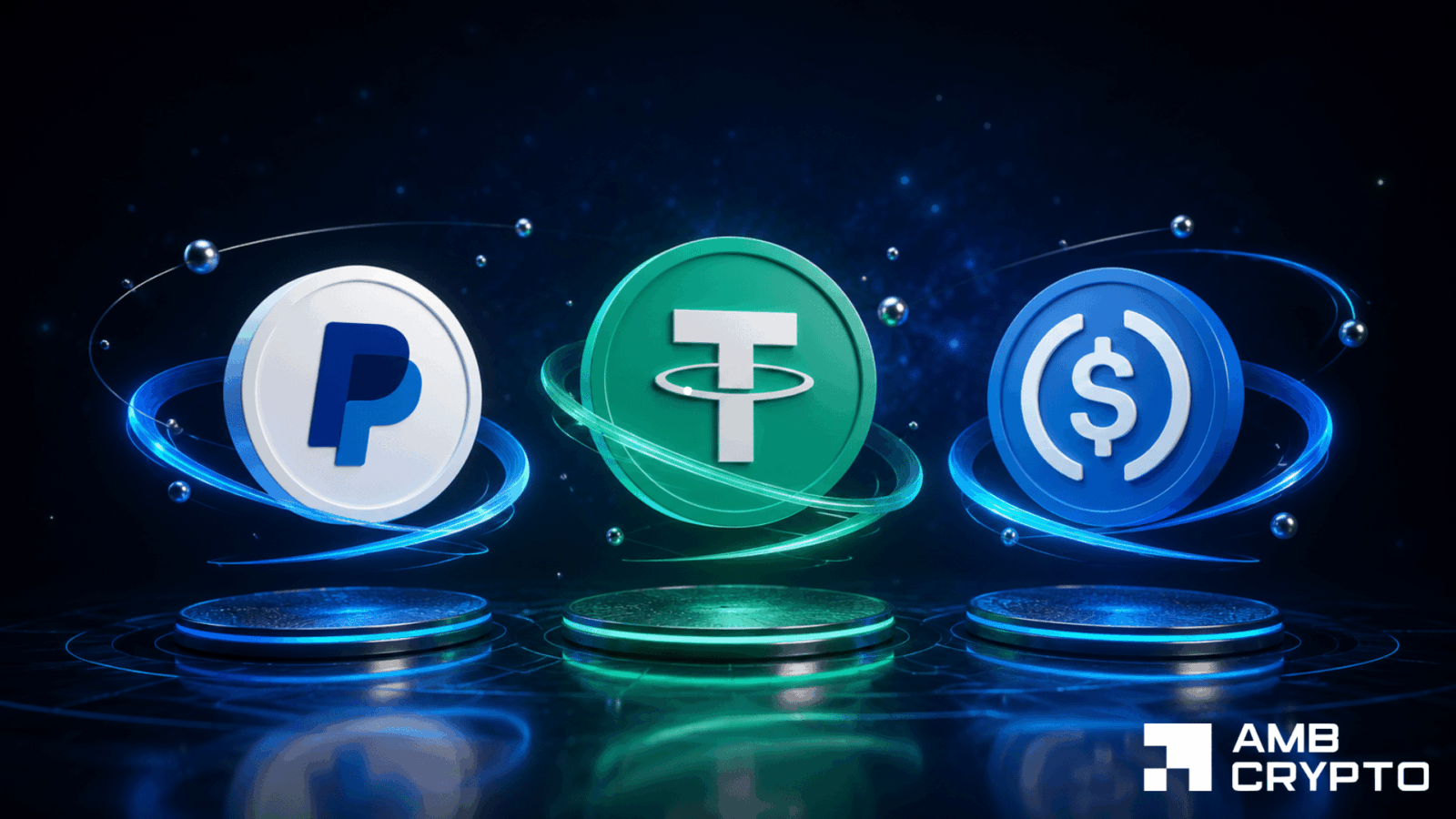
2. Competition Intensifying: Dragonfly Warns of USDT-USDC Duopoly Erosion Rob Hadick from Dragonfly Capital warned that stablecoins are entering a new competitive phase, with emerging alternatives like USDe, USDS, and others beginning to break the historical two-player dominance of Tether and Circle.

3. Ethena & Coinbase Launch USDe High-Yield Vault on Morpho Ethena and Coinbase launched the Steakhouse High Yield Vault on Morpho Protocol, bringing yield opportunities to Coinbase app users and positioning USDe (Ethena's synthetic dollar) as a DeFi-integrated stablecoin competing on yield rather than pure liquidity.
Regulatory & Compliance Tracker
US: No Unified Federal Stablecoin Law Yet (March–June 2026) Despite multiple bills advancing in Congress, the United States still lacks a single comprehensive federal stablecoin statute as of early 2026. Regulation remains fragmented across state and federal authorities.
EU: MiCA Compliance Tightens – 1:1 Reserves & Instant Redemption Required The EU's Markets in Crypto Assets (MiCA) regulation mandates 1:1 reserves, licensed issuance, audited monthly reports, and instant redemption rights. Circle (USDC/EURC) and Paxos (PYUSD) lead compliance; Tether faces ongoing scrutiny despite meeting many global standards.
On-Chain & DeFi Pulse
USDai GPU-Backed Stablecoin Crosses $20M Yield Paid USDai, a stablecoin backed by GPU collateral, has distributed over $20M in yield to users, with staking yields around 8% APY—well above most traditional stablecoin peers. GPU-backed loans now comprise nearly 50% of reserves.
DeFi Lending Platforms Compete on Yield Major platforms (Aave, Morpho, Compound, Spark) now offer stablecoin yields ranging from 5–15% APR, making yield sustainability a key competitive lever as new entrants like USDe and traditional players like USDC vie for TVL in lending protocols.
Analysis: What It Means
The stablecoin market is entering a new phase characterized by fragmentation and yield-driven competition rather than binary dominance. USDT and USDC remain the market leaders—together commanding over 80% of total supply—but their growth is stalling relative to newer entrants. The PYUSD decline signals that even well-funded newcomers struggle to gain traction without differentiation beyond regulatory compliance.
The rise of yield-bearing stablecoins (USDe, USDai, sUSDe) and their integration into mainstream platforms (Coinbase, Morpho) is reshaping the value proposition. Users no longer choose stablecoins solely for liquidity or peg certainty; yield, DeFi integration, and collateral innovation are becoming decision drivers. This mirrors the shift from pure dollar dominance to yield-seeking in the broader crypto ecosystem.
Regulatory clarity—still absent in the US—has become a competitive disadvantage for Tether but an advantage for Circle and PayPal, whose compliance postures attract institutional capital. However, the speed at which regulation moves lags innovation: synthetic dollars (USDe), GPU-backed stablecoins (USDai), and cross-chain variants (USDS, GHO) are evolving faster than rulebooks can keep pace.
What to Watch Next
- US Stablecoin Bill Vote: Congressional passage of unified federal stablecoin legislation could accelerate USDT clarity or trigger redemption pressure if Tether faces reserve disclosure mandates.
- USDC Reserve Audits: Circle's quarterly reserve reports (typically due end-of-month) will show whether large institutional inflows (evidenced by recent transfers) sustain.
- MiCA Full Enforcement Phase (Late 2026): The EU's regulatory grace period winds down; non-compliant stablecoins may face delisting across European exchanges.
- Ethena TVL and sUSDe Yield Sustainability: Monitor whether USDe supply growth accelerates post-Coinbase integration, and whether 20%+ APY yields remain viable given funding cost volatility.
- Emerging Stablecoin M&A or Consolidation: With 10+ credible stablecoins now live, expect announcements of partnerships, integrations, or acquisitions as weaker players seek scale.
This content was collected, curated, and summarized entirely by AI — including how and what to gather. It may contain inaccuracies. Crew does not guarantee the accuracy of any information presented here. Always verify facts on your own before acting on them. Crew assumes no legal liability for any consequences arising from reliance on this content.
Powered by
