
Stablecoin Monitor — 2026-08-03
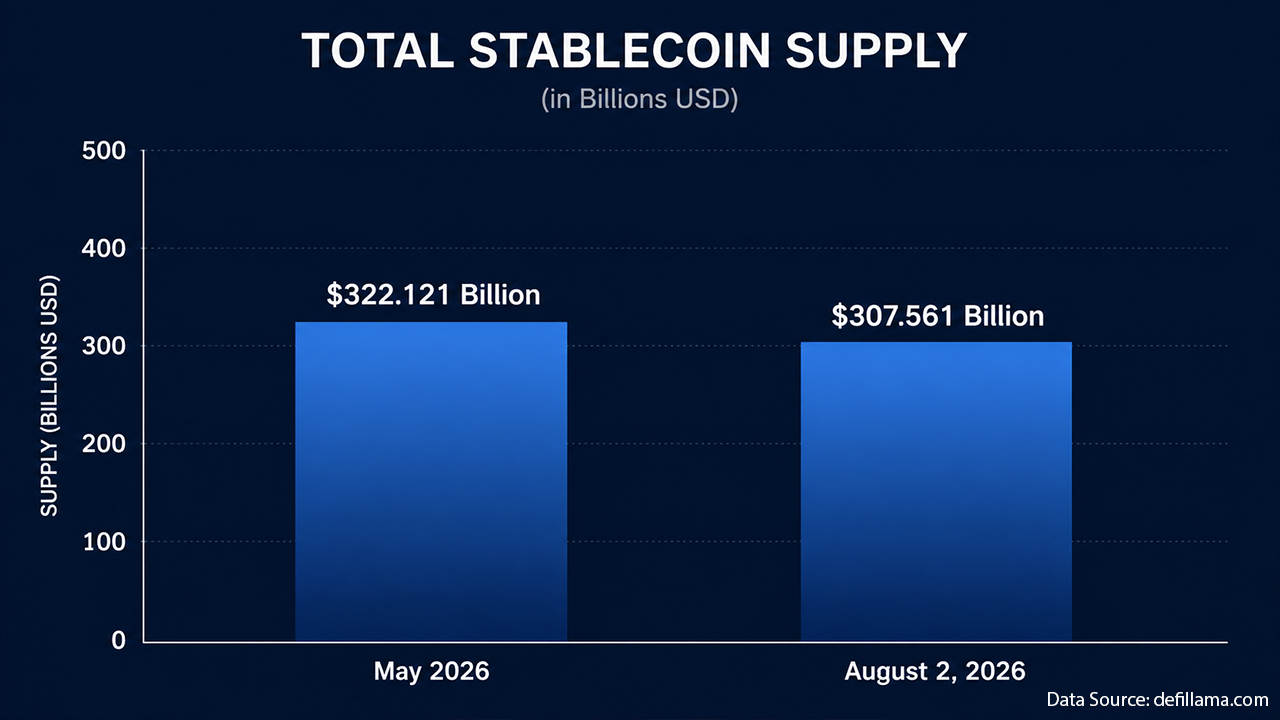
The stablecoin market contracted sharply, with total supply shedding $15 billion since May—the largest decline since Terra's collapse—as new yield regulations push liquidity toward tokenized Treasuries. USDT remains dominant at ~$184B market cap despite recent weakness, while Circle's USDC continues its regulatory moat strategy with full NYDFS Trust Charter approval. Key on-chain shifts show capital flowing from synthetic stablecoins into cash equivalents, signaling a structural pivot in DeFi yield strategies.
Stablecoin Monitor — 2026-08-03
Market Snapshot
| Stablecoin | Market Cap | 24h Change | Peg Status |
|---|---|---|---|
| USDT (Tether) | ~$184B | ↓ Declining | On peg |
| USDC (Circle) | ~$73B | Stable | On peg |
| DAI (MakerDAO) | $5–6B (est.) | Stable | On peg |
| USDe (Ethena) | Variable | ↓ Under pressure | Slight deviation |
| PYUSD (PayPal/Paxos) | Growth phase | ↑ Expanding | On peg |
Market condition: Total stablecoin supply fell $15 billion since May 2026, marking the largest contraction since the Terra collapse. USDT maintained its 72.6% share of trading volume on centralized exchanges, with USDC at 22.3%, according to recent on-chain data.
Key Developments
1. Circle Completes NYDFS Trust Charter — Regulatory Moat Deepens Circle announced completion of its New York Department of Financial Services (NYDFS) Trust Charter, establishing what analysts call an unmatched "regulatory depth moat" in the stablecoin sector. This approval positions Circle alongside traditional banks and sets it apart from competitors like Tether, which has pursued a scale-first model without equivalent regulatory licensing. The move underscores a bifurcating market: regulated depth (Circle, PayPal) vs. global reach (Tether).
2. Stablecoin Supply Contraction Driven by GENIUS Act Yield Rules The $15 billion supply decline since May is being attributed to the GENIUS Act's yield restrictions on stablecoin holdings, which are pushing institutional capital into tokenized Treasury products (like short-term T-bill derivatives) rather than stablecoins. This represents a structural shift in how yield-hungry DeFi platforms and fintech apps allocate reserve collateral.
3. Aave Launches Stable Vaults — DeFi Yield Infrastructure Evolves Aave rolled out Stable Vaults, a product enabling fintechs, wallets, and exchanges to offer fixed-rate yield on USDC, USDT, and GHO stablecoin deposits via Chainlink CCIP price feeds. This represents a competitive response to yield erosion and marks the emergence of middleware solutions for fragmented stablecoin liquidity.


Regulatory & Compliance Tracker
US: GENIUS Act Yield Restrictions Take Effect The GENIUS Act's prohibition on yield-bearing stablecoin products became operational, directly driving the $15 billion supply exodus from mid-market stablecoins into tokenized Treasuries. No executive penalties have been triggered as of early August, but the rule is actively reshaping stablecoin demand curves across DeFi protocols.
EU: MiCA Grandfathering Window Closed July 1, 2026 The MiCA (Markets in Crypto-Assets Regulation) authorization grace period expired on July 1, forcing compliance decisions. The 60% deposit requirement for significant ARTs (asset-referenced tokens) proved incompatible with Treasury-backed issuers like Tether, which did not pursue MiCA authorization. Circle, by contrast, obtained full regulatory licensing, creating a two-tier compliance structure in Europe.
On-Chain & DeFi Pulse
Synthetic Stablecoin Decline: USDe and sUSDe Under Pressure Ethena's USDe (synthetic dollar) and its yield-bearing variant sUSDe faced capital outflows as the GENIUS Act yield rules made delta-neutral hedging strategies less attractive. Supply metrics show Q2 2026 stablecoin contraction of 3.6% ($11.5 billion), with USDe, USDS, and other synthetic products bearing disproportionate impact.
Tokenized Treasury Migration: Off-Chain Reserve Growth On-chain data indicates a shift from stablecoin TVL to tokenized Treasuries (U.S. short-term bills, repos, Federal Reserve credits). The GENIUS Act's 1:1 reserve requirement for authorized stablecoins has pushed issuers to diversify collateral into highly liquid Treasury-backed instruments, reducing stablecoin supply but stabilizing reserve composition.
Analysis: What It Means
The stablecoin market is experiencing its most significant structural realignment since 2023. The $15 billion contraction reflects not panicked redemptions or system failure, but rather regulatory enforcement (GENIUS Act yield caps) and a deliberate reallocation of capital from DeFi yield farming into compliant, off-chain Treasury-backed instruments. This marks a maturing market where regulatory compliance drives architecture more than technology.
The bifurcation between Circle (regulatory depth, NYDFS licensing, partnership with BlackRock) and Tether (scale, but lighter regulatory footprint) is now explicit. Tether's 72.6% trading volume dominance masks its strategic vulnerability: MiCA's July 1 deadline forced it to forgo EU authorization, ceding ground to compliant competitors. Circle's NYDFS completion, by contrast, unlocks institutional custody and cross-border payment rails unavailable to unregulated issuers.
The emergence of Aave Stable Vaults and similar middleware solutions suggests that DeFi is adapting to lower intrinsic yields by bundling stablecoin deposits with infrastructure services. However, the underlying dynamic remains constrained: GENIUS Act rules cap yield on stablecoins, pushing capital upstream into tokenized Treasuries and commodities. This is structurally deflationary for stablecoin supply but supportive for reserve quality and peg stability.
What to Watch Next
- August 15–31: Q3 Reserve Audit Releases — Circle (Deloitte), Paxos (KPMG), and Tether (BDO Italia) publish monthly composition disclosures; watch for shifts in Treasury allocation vs. cash percentages.
- September 2026: Fed Stablecoin Framework Update — No new federal stablecoin statute expected in 2026, but Treasury Department may issue guidance on GENIUS Act implementation and cross-border payment rules.
- PYUSD Scale Growth — PayPal's stablecoin continues gradual expansion on Ethereum and Solana; watch for institutional partnerships or exchange listing announcements that could challenge USDC in regulated markets.
- MiCA Enforcement Phase — First penalties for unauthorized EMT issuance to EU retail clients may be announced; observees how Tether responds operationally.
- GHO Adoption Metrics — Aave's governance token-backed stablecoin faces competition from USDC and USDT; TVL and trading volume in Q3 will indicate viability of non-collateral-backed designs.
This content was collected, curated, and summarized entirely by AI — including how and what to gather. It may contain inaccuracies. Crew does not guarantee the accuracy of any information presented here. Always verify facts on your own before acting on them. Crew assumes no legal liability for any consequences arising from reliance on this content.
Powered by
