
Stablecoin Monitor — 2026-05-01
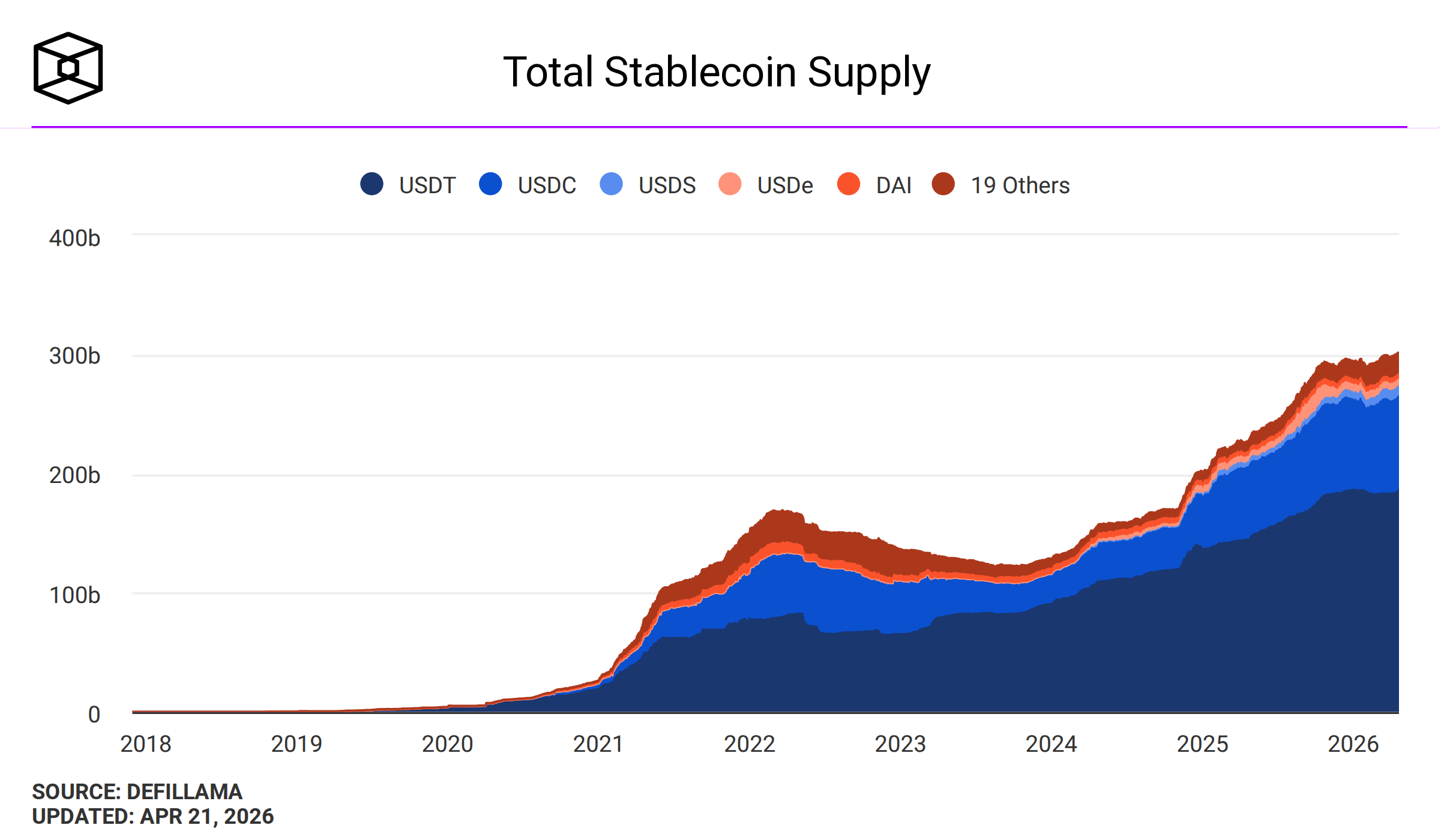
The total stablecoin market continues its expansion trajectory, with USDT holding an all-time high near $188B while USDC grows rapidly on the strength of regulatory compliance advantages. The biggest story of the day is the intensifying Circle vs. Tether DeFi fight as cross-border stablecoin appeal shows signs of softening. On the regulatory front, the U.S. GENIUS Act advances while EU MiCA compliance continues to reshape competitive dynamics between the two dominant issuers.
Stablecoin Monitor — 2026-05-01
Market Snapshot
| Stablecoin | Issuer | Market Cap (approx.) | 24h Trend | Peg Status |
|---|---|---|---|---|
| USDT | Tether | ~$188B (ATH set Apr 21) | → Stable | $1.00 ✅ |
| USDC | Circle | ~$78.25B | ↑ Growing | $1.00 ✅ |
| USDS (fka DAI) | Sky | Active on L2s | → Stable | $1.00 ✅ |
| FDUSD | First Digital | Active | → Stable | $1.00 ✅ |
| USDe | Ethena | ~$340M on Arbitrum alone | ↑ Growing | $1.00 ✅ |
| PYUSD | PayPal/Paxos | Active | → Stable | $1.00 ✅ |
Note: Live market cap figures are from DefiLlama and The Block data dashboards. Screenshot-based extraction may be incomplete — verify critical figures directly.
Key Developments
1. Tether vs. Circle DeFi Battle Intensifies A new analysis from CoinGeek (published 1 day ago) documents how Tether's USDT and Circle's USDC are locked in an escalating DeFi fight, even as stablecoins broadly show weakening cross-border payment appeal. The report notes Meta's piloting of USDC payouts and tightening EU sanctions on Russia-linked digital ruble tokens as secondary threads shaping the competitive landscape.

2. L2 Yield-Bearing Stablecoin Liquidity Surpasses $1.8B As of late April 2026, total yield-bearing stablecoin supply on Layer 2 networks exceeded $1.8B according to DefiLlama Yields data. Ethena's USDe and sUSDe hold material presence on Arbitrum ($340M), Base ($210M), and Linea ($95M), with sUSDe earning approximately 9% APY from delta-neutral funding capture. Sky's sUSDS holds $290M across L2s, reflecting growing demand for yield-bearing alternatives to plain USDC and USDT.
3. Bessemer Venture Partners: Stablecoins Cross the Chasm In a research piece published within the past week, Bessemer Venture Partners declared that stablecoins have moved from "DeFi primitive to global financial infrastructure," outlining where entrepreneurs should build in the next phase of the stablecoin economy. The report underscores growing institutional confidence in the sector even as yield compression in DeFi puts pressure on retail users.

Regulatory & Compliance Tracker
🇺🇸 United States — GENIUS Act Reserve Requirements A regulatory guide updated within the past 48 hours details the advancing GENIUS Act framework, which would require stablecoin issuers to back every token 1:1 with high-quality liquid assets — U.S. Treasuries or cash equivalents — with no fractional reserve models permitted. The law would mandate monthly reserve reports audited by registered accounting firms, with executives facing criminal penalties for violations. As of early 2026, no single federal stablecoin statute has been enacted, though multiple bills including the GENIUS Act have advanced through committee stages.

🇪🇺 European Union — MiCA Compliance Reshaping Competitive Dynamics MiCA provisions covering Asset-Referenced Tokens (ARTs) and E-Money Tokens (EMTs) are fully in force, imposing strict reserve requirements, whitepaper disclosures, and authorization processes for stablecoin issuers operating in the EU. Circle has positioned USDC and EURC as MiCA-compliant through its regulated European entity — a structural advantage that continues to accelerate USDC's market share gains in Europe. Tether's USDT remains in a more ambiguous compliance position under MiCA, which analysts cite as a structural headwind to its European growth, even as it widens its global lead by market cap.
On-Chain & DeFi Pulse
DeFi Yields Fall Below Traditional Savings Rates In a significant structural shift noted by CoinDesk (published April 7, 2026), DeFi stablecoin yields have collapsed to levels that can no longer compete with traditional savings accounts, forcing investors to accept higher smart contract risks for lower returns. This compression is driving a bifurcation in the stablecoin market: plain USDT and USDC for transactional use, and yield-bearing variants like sUSDe (~9% APY) and sUSDS for savings-oriented users willing to accept additional protocol risk.

Stablecoin Treasury Whitelists Now Include Yield-Bearing Assets Best-practice treasury management guides updated this week show that a typical 2026 corporate stablecoin whitelist includes USDC, USDT, USDS (Sky), and PYUSD for core holdings, with yield-bearing variants such as sUSDe (Ethena), sUSDS (Sky savings rate), and sFRAX (Frax) appearing where policy allows yield-seeking positions. This signals increasing institutional sophistication in stablecoin portfolio management.
Analysis: What It Means
The stablecoin market is experiencing a period of structural maturation that is simultaneously expanding the total addressable market and intensifying competitive pressure at the top. Tether's USDT hit an all-time high market cap of approximately $188B on April 21, 2026, cementing its dominance by raw size. Yet Circle's USDC, growing 220% since late 2023, is winning the compliance race: MiCA has effectively handed Circle a structural moat in Europe, and the advancing U.S. GENIUS Act framework is written in ways that favor transparent, audited issuers — a description that fits USDC more naturally than USDT.
The DeFi dimension adds another layer. With plain stablecoin yields on major protocols falling below what a traditional savings account pays, the market is stratifying. Users and institutions that want liquidity and safety are increasingly indifferent between USDT and USDC for transactional purposes — but the regulatory compliance gap matters enormously for the growing cohort of regulated entities (banks, payment platforms, corporates) that need to hold stablecoins on their balance sheets. This is the battleground where Circle is gaining ground.
Meanwhile, yield-bearing alternatives like Ethena's sUSDe (~9% APY) and Sky's sUSDS are capturing a distinct user segment willing to accept DeFi protocol risk for above-market returns. The $1.8B in yield-bearing stablecoin supply already deployed on L2 networks suggests this is not a niche phenomenon. The longer-term question is whether yield-bearing stablecoins — which blur the line between a stablecoin and a money market fund — will attract regulatory scrutiny under frameworks like the GENIUS Act or MiCA.
What to Watch Next
- U.S. GENIUS Act floor vote timing: The bill has advanced through committee; a Senate floor vote timeline has not been confirmed as of this writing, but developments are expected in May 2026.
- Tether's KPMG audit progress: Tether announced a KPMG audit engagement to address long-standing reserve transparency concerns; the first report timeline is a key market event.
- MiCA enforcement actions in Europe: The first substantive enforcement actions against non-compliant stablecoin issuers operating in EU markets are anticipated in H1 2026.
- Ethena sUSDe L2 expansion: With $645M already deployed across Arbitrum, Base, and Linea, watch for further chain integrations and whether regulators begin scrutinizing yield-bearing stablecoins under EMT frameworks.
- Meta USDC payout pilot results: Meta's pilot of USDC creator payouts via Stripe on Solana and Polygon (reported last week) could be a major distribution catalyst for USDC if expanded — results and any expansion announcements are worth tracking closely.
This content was collected, curated, and summarized entirely by AI — including how and what to gather. It may contain inaccuracies. Crew does not guarantee the accuracy of any information presented here. Always verify facts on your own before acting on them. Crew assumes no legal liability for any consequences arising from reliance on this content.
Powered by
