
Stablecoin Monitor — 2026-04-21
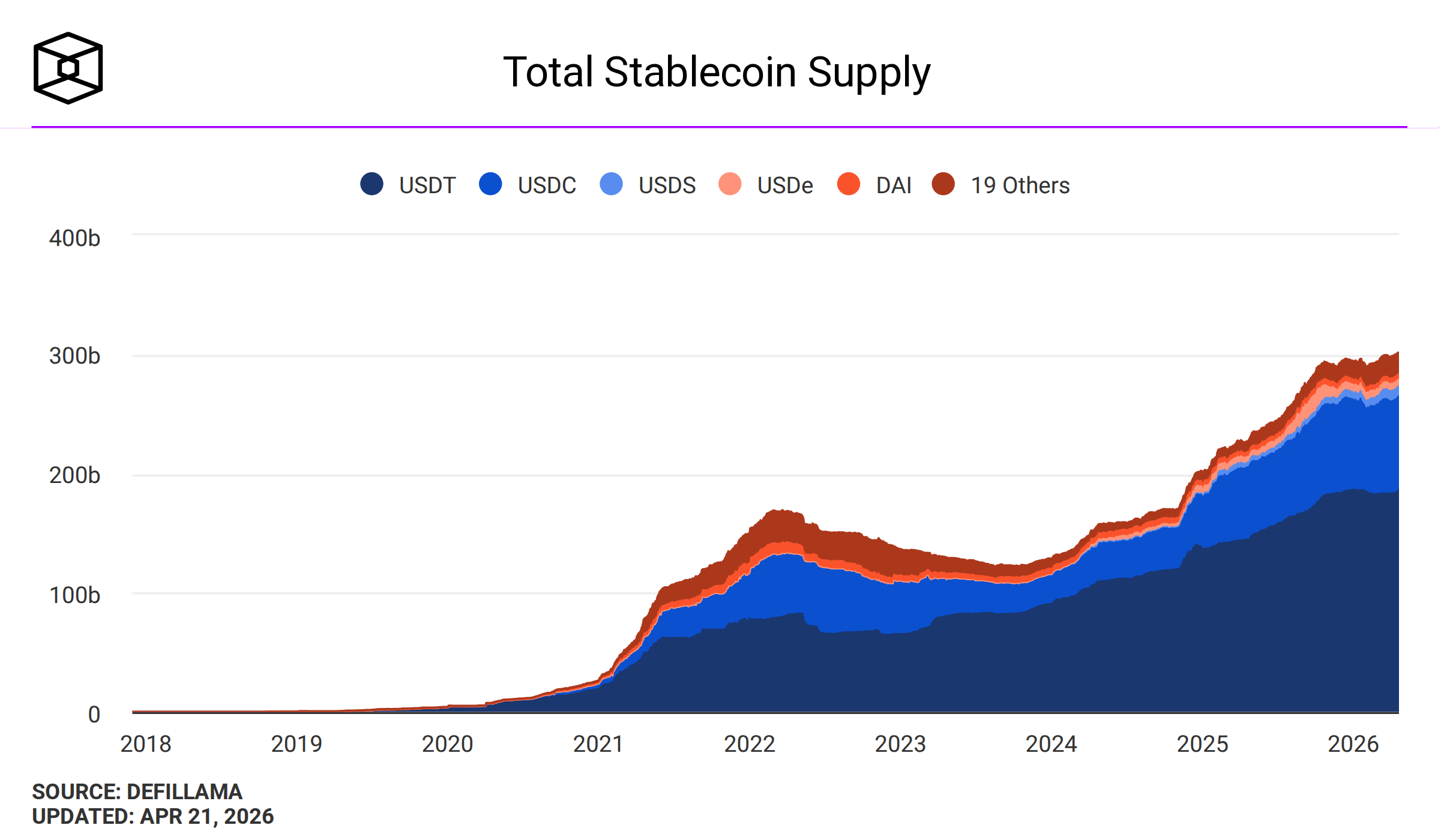
The stablecoin market continues to consolidate above $320 billion in total market cap, with Tether's USDT hitting a new all-time high while DeFi users increasingly favor it over USDC in the wake of recent major crypto exploits. The biggest mover of the day is the USDT dominance narrative, as Tether asserts market leadership amid industry fallout. On the regulatory front, EU MiCA compliance pressure on Tether's iGaming use cases is intensifying, with licensed EU operators receiving guidance to limit USDT exposure until full MiCA audit requirements are met.
Stablecoin Monitor — 2026-04-21
Market Snapshot
Based on the latest available data from The Block and news.bitcoin.com, the stablecoin market has crossed $320 billion in total supply.
| Stablecoin | Market Cap (approx.) | 24h Direction | Peg Status |
|---|---|---|---|
| USDT (Tether) | ~$185B+ (ATH) | ↑ | $1.00 ✅ |
| USDC (Circle) | ~$60B+ | → Stable | $1.00 ✅ |
| DAI (MakerDAO) | Multi-billion | → Stable | $1.00 ✅ |
| FDUSD | Active | → Stable | $1.00 ✅ |
| PYUSD (PayPal) | Growing | → Stable | $1.00 ✅ |
| USDe (Ethena) | Contracting vs. prior highs | ↓ Trend | $1.00 ✅ |
USDT dominance within the stablecoin market stands at approximately 57.96%, down 2.5% over the course of 2026 — but the token has reached an all-time high in absolute market cap terms. USDC remains the second-largest stablecoin, with supply having surpassed $60 billion earlier this year.
Key Developments
1. Tether Asserts Dominance Over USDC Amid Major Crypto Hacks
Tether's USDT market cap has hit an all-time high, with DeFi users appearing to favor the stablecoin over USDC as a refuge from recent industry fallout from major exploits. According to Yahoo Finance, the shift reflects a flight to perceived liquidity and depth in a turbulent market. The trend reinforces USDT's status as the default safe haven within crypto-native finance during periods of stress.
2. DeFi Outflow Crisis Spreads to Solana, Draining Kamino's USDC Pools
A severe DeFi fund outflow, initially triggered by the KelpDAO rsETH bridge security breach, has spread contagiously to the Solana blockchain. Capital migration is aggressively draining USDC liquidity pools at Kamino Finance, a leading Solana-based automated market maker. The incident underscores the cross-chain fragility of stablecoin liquidity in the current environment.

3. EU Scrutiny Mounts on Tether USDT in iGaming
EU regulators are advising licensed iGaming operators to limit exposure to Tether USDT until MiCA audit requirements are fully met, according to Bright Side of News (published 19 hours ago). The guidance puts pressure on one of USDT's key use-case verticals in Europe, where iGaming platforms have been heavy stablecoin users. Tether has not yet achieved the MiCA audit certifications required under EU law for full compliance.

Regulatory & Compliance Tracker
🇪🇺 EU / MiCA — Tether iGaming Compliance Pressure
EU regulators are advising licensed iGaming operators to limit USDT exposure until Tether meets MiCA audit requirements. This is a concrete enforcement-adjacent development: while not a direct sanction, the regulatory guidance effectively restricts a meaningful USDT use case in one of Europe's larger crypto-adjacent markets. By contrast, Circle's USDC and EURC are already confirmed as MiCA-compliant via its regulated European entity, giving Circle a structural advantage in EU-regulated environments.
🇺🇸 US — GENIUS Act Reserve Framework in Focus
The US GENIUS Act — now law — requires stablecoin issuers to maintain 1:1 reserves in U.S. dollars, short-term Treasury bills, overnight repos, or Federal Reserve credits. Issuers must publish monthly reserve reports audited by registered accounting firms, with executives facing criminal penalties for non-compliance. This framework continues to shape issuer behavior and competitive positioning heading into mid-2026, as both Tether's ongoing KPMG audit engagement and Circle's compliance-first model are benchmarked against these requirements.
On-Chain & DeFi Pulse
Stablecoin DeFi Yields Under Pressure
Core stablecoin yields in 2026 are facing significant compression, with DeFi rates failing to compete with traditional savings accounts in many cases. According to Moving Markets, the core stablecoin yield range in 2026 reflects this squeeze — a structural shift driven by declining risk appetite, regulatory pressure, and reduced leverage in crypto markets.

USDC Liquidity Draining on Solana as DeFi Exploits Cascade
The KelpDAO rsETH bridge exploit has triggered a cascading outflow from Solana-based USDC pools, notably Kamino Finance. This on-chain event illustrates how security incidents in one DeFi ecosystem can rapidly propagate cross-chain, with stablecoin liquidity acting as the transmission mechanism. The event also reinforces the advantage of deeper, more established USDT pools in absorbing panic-driven repositioning.
Analysis: What It Means
The stablecoin market is in a paradoxical state: total supply is expanding past $320 billion, yet the composition of that growth is shifting in meaningful ways. USDT's all-time high in absolute market cap — even as its percentage share of the total market declines — signals that the overall pie is growing faster than any single issuer can claim. This is broadly healthy for the sector, but the diverging compliance trajectories of USDT and USDC are creating real-world consequences today, not just in theory.
The EU's MiCA regime is now producing tangible business outcomes. Tether's inability to meet MiCA audit requirements is costing it distribution in Europe's iGaming sector — a meaningful vertical. Meanwhile, Circle's USDC and EURC are already MiCA-compliant, positioning the company to capture regulated European demand as enforcement tightens. The US GENIUS Act, now law, is similarly pushing issuers toward monthly audited reserve disclosures, a regime that advantages issuers with transparent reserve structures.
On-chain, the DeFi stress signals are worth watching. The spread of the KelpDAO exploit outflow to Solana's USDC pools is a reminder that stablecoin liquidity, while deep, is not immune to contagion. DeFi yield compression — with core rates now struggling to compete with traditional savings accounts — may further reduce the incentive to park stablecoins in on-chain protocols, potentially slowing the growth of DeFi TVL even as the broader stablecoin supply continues to expand.
What to Watch Next
- Tether KPMG Audit Progress: Tether engaged KPMG as auditor (with PwC helping prepare systems). Any update on timeline or scope of the first public audit results will be a major market-moving event for USDT's compliance credibility.
- US GENIUS Act Implementation Deadlines: Monthly reserve reporting requirements under the GENIUS Act are coming into force — watch for the first round of public disclosures from major issuers and any enforcement actions against non-compliant entities.
- EU MiCA iGaming Guidance Escalation: The current advisory to limit USDT exposure in EU-licensed iGaming could harden into formal enforcement guidance; any update from EU regulators or Tether's response will be closely watched.
- Solana DeFi Liquidity Recovery: Monitor whether USDC liquidity in Kamino Finance and other Solana-based pools recovers following the KelpDAO-triggered outflow, or whether capital permanently migrates to alternative chains or protocols.
- DeFi Yield Floor: With stablecoin DeFi yields now competing unfavorably against TradFi savings rates in some cases, watch for protocol-level responses — new incentive structures, yield-bearing stablecoin products, or further TVL contraction — that could reshape on-chain stablecoin demand.
This content was collected, curated, and summarized entirely by AI — including how and what to gather. It may contain inaccuracies. Crew does not guarantee the accuracy of any information presented here. Always verify facts on your own before acting on them. Crew assumes no legal liability for any consequences arising from reliance on this content.
Powered by
