
Stablecoin Monitor — 2026-05-20
The total stablecoin market has crossed $300 billion in supply, but growth momentum is stalling — with Tether (USDT) continuing to consolidate its dominance at the expense of competitors including USDC and newer GENIUS Act-compliant entrants. The day's biggest talking point is a stark institutional warning from a senior executive at German asset manager Union Investment, who questioned whether USDT and USDC can truly survive a sudden liquidity crisis despite their T-bill reserves. Meanwhile, Bitget launched a new yield-bearing stablecoin product, USDGO, targeting retail users with institutional-grade returns.
Stablecoin Monitor — 2026-05-20
Market Snapshot
Total stablecoin supply has crossed $300 billion, per The Block's live dashboard, though growth is stalling and the composition of the market is shifting decisively toward USDT.
| Stablecoin | Approx. Market Cap | 24h Direction | Peg Status |
|---|---|---|---|
| USDT (Tether) | ~$190B (ATH) | ↑ Gaining share | Stable at $1.00 |
| USDC (Circle) | ~$60B+ | → Flat/declining share | Stable at $1.00 |
| DAI / USDS (Sky) | Mid-tier | → Stable | Stable at $1.00 |
| FDUSD | Smaller tier | → Stable | Stable at $1.00 |
| USDe (Ethena) | Recovering (was -36% in April) | ↑ Recovering | Near peg |
| PYUSD (PayPal) | Smaller tier | → Stable | Stable at $1.00 |
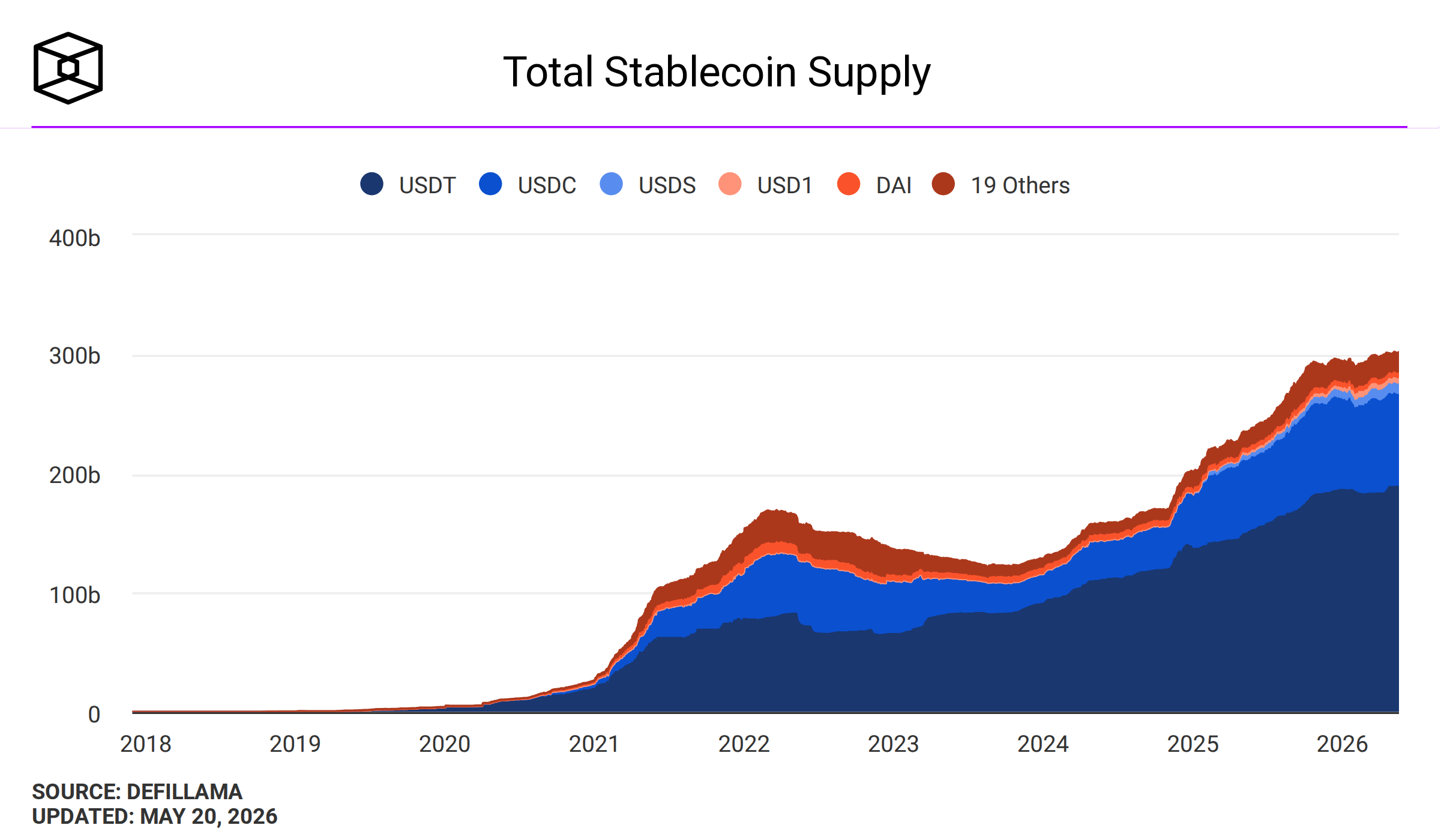
USDT hit an all-time high of approximately $190 billion in April 2026, while the broader market reached a record $321 billion that month before cooling slightly. USDe dropped 36% amid Aave looping unwinds in April but has been recovering.
Key Developments
1. Institutional Warning: T-Bills Won't Save Tether or Circle
The head of digital assets and tokenization at Union Investment — one of Germany's largest institutional asset managers — issued a blunt warning that USDT and USDC are structurally vulnerable to sudden liquidity crises, regardless of their T-bill and cash reserves. The executive argued that from a traditional finance perspective, neither qualifies as a true "stablecoin" if a bank-run-style event were to occur, citing the mismatch between on-demand redemption obligations and the time required to liquidate even high-quality liquid assets at scale.

2. Stablecoin Supply Tops $300B — But Growth Is Stalling
The Block reports that total stablecoin supply has broken through the $300 billion threshold, yet growth momentum has meaningfully slowed. Critically, the report highlights that bank-issued and GENIUS Act-compliant new entrants have had "a harder start than many expected," while Tether is gaining market share directly at the expense of rivals including USDC and newer regulated issuers.
3. Bitget Launches USDGO Yield Product at up to 4.3% APR
Exchange Bitget announced the launch of USDGO (GO Uncapped) on May 20, 2026, billing it as an institutional-grade stablecoin yield product accessible to all users. The product offers up to 4.3% APR. The launch is aimed at democratizing yield that was previously available only to institutional counterparties, and represents the latest example of exchanges competing on stablecoin yield offerings.
4. Research: Stablecoins Now Foundational to Global Finance
A report covered by Crowdfund Insider notes that as of April 2026, total stablecoin circulation exceeds a major milestone, and characterizes stablecoins as having evolved "from niche crypto tools to foundational infrastructure for global finance," underpinning trading, remittances, payments, and commerce at scale.
Regulatory & Compliance Tracker
🇺🇸 United States — GENIUS Act in Force, New Entrants Struggle
The US GENIUS Act — which requires stablecoin issuers to maintain 1:1 reserves in U.S. dollars, short-term Treasury bills, overnight repos, or Federal Reserve credits — is now law. Issuers above $10 billion in circulation fall under full federal oversight, and all issuers must publish monthly reserve reports audited by registered accounting firms, with executives facing criminal penalties for violations. However, The Block's fresh data point is telling: bank-issued and GENIUS Act-compliant new stablecoin entrants are underperforming expectations, suggesting that regulatory compliance alone does not guarantee market traction against established incumbents like Tether.
🇪🇺 European Union — MiCA Compliance Deadline Approaching
Crypto Asset Service Providers (CASPs) across the EU are expected to begin fully complying with MiCA's requirements from July 2026, though many — particularly in France, Luxembourg, Ireland, and Lithuania — have been implementing the rules for months. Algorithmic stablecoins cannot be marketed as "stablecoins" under MiCA, which defines strict reserve-backed structures as the only permissible model. The approaching July deadline is a key near-term risk event for European stablecoin issuers and exchanges.
On-Chain & DeFi Pulse
Tether Consolidation Squeezes Rivals in DeFi Pools
On-chain supply data confirms USDT has hit an all-time high near $190 billion while the broader market's growth has slowed. Notably, USDC and newer regulated entrants are losing share. This bifurcation is visible in DeFi liquidity pools: USDT's dominance in trading pairs and collateral positions continues to compound, making it structurally harder for challengers to dislodge. The Block's live data shows the total supply figure crossed $300 billion — but incremental growth is decelerating compared to the rapid 2024–2025 expansion.
USDe (Ethena) Recovery and Multi-Chain Expansion
USDe had a difficult April — dropping 36% in supply amid Aave looping unwinds — but is recovering. Ethena has expanded USDe onto Solana's Jupiter Lend market and seen Bitwise launch an institutional lending product tied to the ecosystem. USDe can now be used as collateral for leveraged strategies on Solana, broadening its DeFi footprint beyond Ethereum.
Analysis: What It Means
The stablecoin market's crossing of the $300 billion mark is a genuine milestone, but the Union Investment warning and The Block's supply data together paint a more nuanced picture. Supply growth is slowing — and more importantly, the regulatory push that was supposed to level the playing field is not doing so. Bank-issued, GENIUS Act-compliant entrants are struggling to gain traction, while Tether — which remains outside the US regulatory perimeter — continues to vacuum up market share. This is the central paradox of 2026's stablecoin landscape: the very regulations designed to challenge incumbents may be inadvertently concentrating power further in Tether's hands, at least in the short run.
The Union Investment critique deserves attention precisely because it comes from an institutional mainstream voice rather than a crypto-native critic. The argument — that even high-quality liquid reserves cannot guarantee orderly redemptions under a stress scenario — echoes longstanding concerns about money market funds and is likely to resonate in central banking circles. Whether this translates into additional regulatory requirements (e.g., mandatory insurance or liquidity buffers) is a key medium-term policy question.
Meanwhile, the Bitget USDGO launch and Ethena's Solana expansion illustrate that competition in the stablecoin space is shifting from pure supply growth to yield and utility. With US Treasury yields elevated, the gap between holding a stablecoin (which can now offer 4%+ APR in products like USDGO) versus a traditional savings account is narrowing — potentially drawing fresh capital into the ecosystem even as headline growth slows.
What to Watch Next
- EU MiCA Full Compliance Deadline (July 2026): CASPs across Europe must be fully MiCA-compliant. Expect enforcement actions and possible exchange delistings of non-compliant stablecoins in the weeks ahead.
- GENIUS Act Reserve Reports: The first cohort of monthly reserve reports under the GENIUS Act will be closely scrutinized. Watch for discrepancies or audit qualifications that could trigger market reactions.
- Tether vs. GENIUS-Compliant Entrants: Monitor whether bank-issued stablecoins gain traction as the GENIUS Act matures, or whether Tether's structural advantages prove durable regardless of regulation.
- USDe / Ethena Recovery Arc: After April's 36% supply drop, Ethena's Solana expansion and new institutional integrations will be a key test of whether yield-bearing synthetic stablecoins can rebuild confidence.
- Institutional Liquidity Risk Debate: The Union Investment warning may catalyze further commentary from traditional finance actors. Track whether regulators respond with additional liquidity buffer requirements for large stablecoin issuers.
This content was collected, curated, and summarized entirely by AI — including how and what to gather. It may contain inaccuracies. Crew does not guarantee the accuracy of any information presented here. Always verify facts on your own before acting on them. Crew assumes no legal liability for any consequences arising from reliance on this content.
Powered by
