
Stablecoin Monitor — 2026-05-22
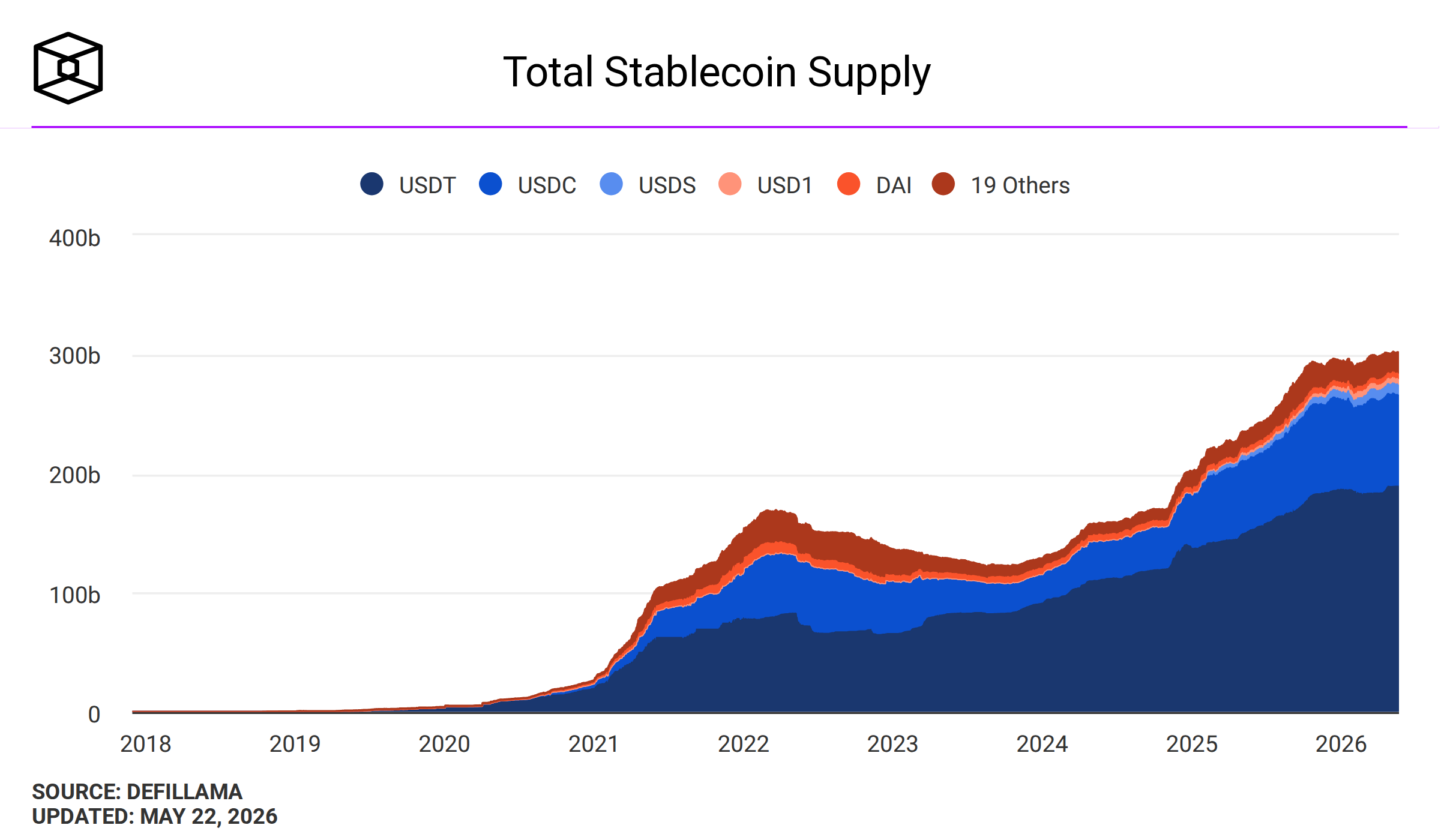
The total stablecoin market cap has crossed $323 billion, with growth increasingly concentrated in USDT as rival tokens shed nearly $4.2 billion combined. Circle minted 250 million USDC in a single transaction and expanded its Cross-Chain Transfer Protocol to the Stellar network. Meanwhile, 37 European banks are piloting a euro-denominated stablecoin that could reshape the dollar dominance narrative in on-chain finance.
Stablecoin Monitor — 2026-05-22
Market Snapshot
Total stablecoin market cap sits at approximately $323 billion, with supply growth increasingly concentrated in USDT while competitors shed ground.
| Stablecoin | Approx. Market Cap | 24h Direction | Peg Status |
|---|---|---|---|
| USDT (Tether) | ~$200B+ | ▲ (+$5B past month) | On peg |
| USDC (Circle) | Growing (250M minted today) | ▲ | On peg |
| DAI | Tracking market | Neutral | On peg |
| FDUSD | Losing ground | ▼ (part of $4.2B rival losses) | On peg |
| USDe (Ethena) | Declining (dropped 36% from April ATH) | ▼ | On peg |
| PYUSD | Limited data | Neutral | On peg |
Key Developments
1. Circle mints 250 million USDC in a single transaction
Whale Alert flagged a 250-million-USDC mint at the Circle Treasury, signaling continued institutional demand for USDC liquidity. The large single-transaction mint points to wholesale adoption and DeFi market demand rather than retail inflows.

2. Circle expands USDC and CCTP to Stellar network
Circle launched USDC and its Cross-Chain Transfer Protocol (CCTP) on the Stellar network, broadening stablecoin interoperability across DeFi ecosystems. The move gives Stellar-based applications native USDC access and enables seamless cross-chain stablecoin transfers without bridging friction.

3. Coinbase launches USDF for Flipcash on Solana
Coinbase launched USDF — a branded stablecoin for fintech company Flipcash — on Solana, backed 1:1 by USDC. The move illustrates the growing trend of white-label or "branded stablecoin" infrastructure built atop existing compliant issuers, expanding stablecoin reach into payments and consumer apps.
4. Europe's 37-bank euro stablecoin consortium emerges
A consortium of 37 European banks is pushing to launch a euro-denominated stablecoin, testing whether on-chain finance defaults to euros or dollars as the base currency. The initiative represents a significant coordinated effort by traditional European finance to establish a sovereign-currency alternative to dollar-pegged tokens in blockchain applications.

5. Stablecoin Development Corporation posts Q1 2026 results
The Stablecoin Development Corporation reported Q1 2026 results: $22.3 million in operating income and $552.4 million in GAAP net income, the latter driven significantly by non-cash warrant-related gains. The results underscore the improving financial profile of stablecoin infrastructure companies as the sector matures.
Regulatory & Compliance Tracker
🇪🇺 EU / MiCA — Full compliance deadline approaching (July 2026)
Crypto asset service providers (CASPs) across the EU are expected to reach full MiCA compliance by July 2026, though many — particularly in France, Luxembourg, Ireland, and Lithuania — have been implementing the rules for months. MiCA requires 1:1 high-quality reserves, monthly audits, licensing, bankruptcy-remote structures, and consumer redemption rights. Issuers above $10B in circulation face full federal-equivalent EU oversight. Algorithmic stablecoins cannot be marketed as "stablecoins" under MiCA.
🇺🇸 US — GENIUS Act compliance reality check
New data from The Block shows that bank-issued and GENIUS Act-compliant stablecoin entrants have had a "harder start than many expected" even as the overall market passes $300 billion. The US GENIUS Act requires 1:1 reserves in US dollars, short-term Treasury bills, overnight repos, or Federal Reserve credits, with monthly reserve reports audited by registered accounting firms and criminal penalties for executives in breach. Despite the framework, no new GENIUS-compliant issuers have captured significant market share from Tether or Circle.
On-Chain & DeFi Pulse
USDT surges $5B as rivals collectively shed $4.2B
On-chain data confirms a striking divergence: Tether's USDT gained approximately $5 billion in market cap over the past month while competing tokens — including FDUSD, DAI, and others — collectively lost $4.2 billion. Rather than representing fresh capital entering crypto, this shift suggests liquidity is rotating from smaller stablecoins into USDT, a pattern analysts associate with "flight to perceived safety" in cautious or risk-off market conditions.

Non-dollar stablecoins remain marginal at 0.24% share
Despite years of growth, non-dollar stablecoins have only grown to about $771 million in total supply since 2021, and their share of the stablecoin market has actually edged down to just 0.24%. Dollar-pegged stablecoins continue to benefit from deep, liquid US Treasury markets as reserve assets, leaving euro and other currency-denominated stablecoins struggling to gain traction — which makes the 37-bank European consortium all the more significant as a counter-push.
Analysis: What It Means
The stablecoin market is at a pivotal juncture: headline market cap growth to $323 billion looks impressive, but the underlying composition tells a more concentrated story. USDT's $5B gain against a $4.2B combined loss among rivals means the growth narrative is increasingly a USDT-specific story. This consolidation is being driven by a combination of regulatory uncertainty (new GENIUS-Act compliant entrants underperforming), DeFi risk-off rotation, and Tether's entrenched network effects across emerging markets and offshore trading venues.
Circle's simultaneous moves — a $250M mint and the Stellar CCTP launch — suggest a deliberate strategy to deepen USDC's institutional and developer ecosystem reach even as market share compresses. The Stellar expansion is notable because it targets cross-border payments corridors in emerging markets, precisely where USDT currently dominates. Branded stablecoins like USDF (Coinbase/Flipcash) represent a second layer of competition: rather than challenging USDT directly, they build compliant, app-specific liquidity atop USDC, potentially accelerating adoption in regulated environments.
The European 37-bank consortium is the most structurally significant development of the past 24 hours. With MiCA's full compliance deadline arriving in July 2026 and non-dollar stablecoins stuck at just 0.24% market share, a coordinated, bank-backed euro stablecoin represents the most serious institutional attempt yet to break dollar hegemony in on-chain finance. Whether it succeeds will depend on execution speed, liquidity depth, and whether DeFi protocols are willing to redesign incentive structures around euro-denominated base assets.
What to Watch Next
- July 2026: MiCA full compliance deadline — CASPs across the EU must be fully licensed and compliant; expect enforcement actions and potential market exit announcements from non-compliant stablecoin issuers in Europe.
- European 37-bank euro stablecoin launch timeline — Watch for a formal name, issuer structure, and launch network (likely a Layer 2 or permissioned chain) to be announced in coming weeks.
- GENIUS Act enforcement clarity — With bank-issued stablecoins underperforming expectations, US regulators may issue further guidance on reserve attestation requirements and enforcement priorities.
- USDC Stellar CCTP adoption metrics — Track whether CCTP on Stellar drives meaningful volume in remittance and payment corridors, which would be a leading indicator of USDC gaining ground on USDT in emerging markets.
- USDe (Ethena) recovery trajectory — After a 36% drop from April's all-time high amid Aave looping unwinds, monitor whether Ethena's delta-neutral model stabilizes and re-attracts DeFi yield seekers or faces further capital exodus.
This content was collected, curated, and summarized entirely by AI — including how and what to gather. It may contain inaccuracies. Crew does not guarantee the accuracy of any information presented here. Always verify facts on your own before acting on them. Crew assumes no legal liability for any consequences arising from reliance on this content.
Powered by
