
Stablecoin Monitor — 2026-04-30
The stablecoin market continues its expansion, with total supply rising to over $305 billion even as on-chain transfer volume dipped 19% in the past 30 days — a divergence suggesting capital is accumulating rather than circulating. The biggest story of the day is Meta's official launch of USDC-based creator payouts via Stripe on Solana and Polygon, marking a landmark moment for stablecoin payments adoption. On the regulatory front, the U.S. Stablecoin Act of 2026 is placing Circle and Tether at the center of an intensifying legislative battle over market structure.
Stablecoin Monitor — 2026-04-30
Market Snapshot
Based on available data from recent reporting, the stablecoin market stands as follows:
| Stablecoin | Approx. Market Cap | 24h Direction | Peg Status |
|---|---|---|---|
| USDT (Tether) | ~$188B (ATH set Apr 21) | Stable/↑ | On peg ($1.00) |
| USDC (Circle) | ~$78.25B | Stable | On peg ($1.00) |
| FDUSD | Tracking growth | Stable | On peg |
| USDe (Ethena) | Growing | Stable | On peg |
| DAI (MakerDAO) | Tracking market | Stable | On peg |
| PYUSD (PayPal) | Backed by USD deposits & Treasuries | Stable | On peg |
Total stablecoin supply reached approximately $305.29 billion, per DiarioBitcoin's April 28 report. On-chain transfer volume fell 19.18% to $831B over 30 days, while supply, holders, and active addresses continued to rise.
Key Developments
1. Meta Launches USDC Creator Payouts on Solana and Polygon via Stripe
Meta has officially rolled out stablecoin-based payouts to content creators in select countries, using Circle's USDC on the Solana and Polygon blockchains — processed through Stripe. The move comes roughly four years after Meta shelved its controversial Libra/Diem project and represents one of the largest Web2-to-Web3 payment integrations to date. Creators on Facebook and Instagram can now receive compensation in USDC, signaling a new chapter for stablecoin payments at scale.

2. Stablecoins Hit $4.5T Q1 2026 Transfer Volume Record — Asia Driving Two-Thirds
A new report from a16z revealed that stablecoin transfer volume hit a record $4.5 trillion in Q1 2026, with nearly two-thirds of flows originating from Asia. The figure underscores accelerating adoption of dollar-denominated stablecoins for cross-border payments and commerce, even as on-chain velocity has moderated month-over-month.
3. Circle vs. Tether DeFi Battle Intensifies; EU Tightens Sanctions on Digital Ruble-Linked Tokens
CoinGeek reported (9 hours ago) that Circle and Tether are locked in an escalating DeFi market share battle, with Meta's USDC payout pilot adding fresh momentum to Circle's compliance-forward strategy. Separately, the EU has tightened sanctions targeting Russia and tokens linked to the digital ruble, further constricting the operational footprint of less-regulated stablecoins in European markets.

Regulatory & Compliance Tracker
🇺🇸 United States — GENIUS Act / U.S. Stablecoin Act of 2026
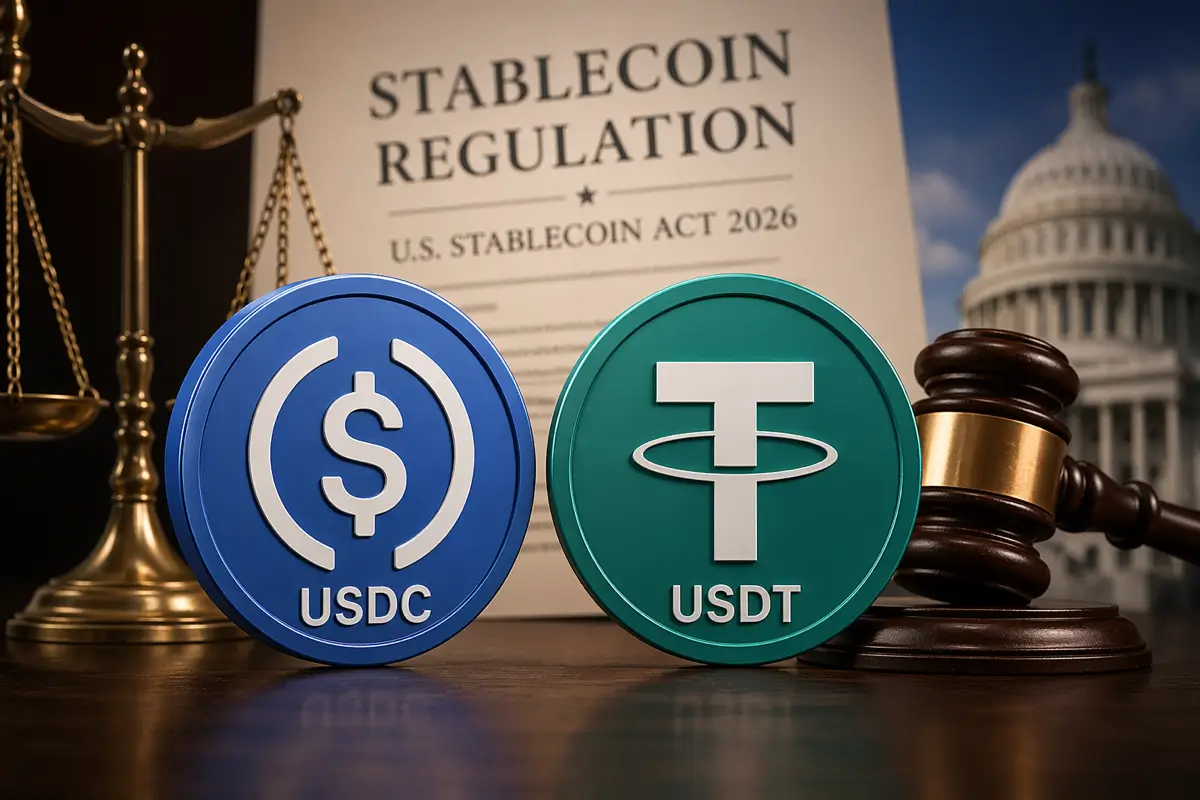
The U.S. Stablecoin Act of 2026 has placed both Tether and Circle at the legislative epicenter of Washington's stablecoin debate. Under the emerging framework, issuers would be required to maintain 1:1 reserves in U.S. dollars, short-term Treasury bills, overnight repos, or Federal Reserve credits, with mandatory monthly reserve reports audited by registered accounting firms. Executives could face criminal penalties for non-compliance. As PaySpace Magazine noted this week, Tether's dominant ~60% market share faces structural pressure from compliance-optimized rivals like Circle's USDC, which has surged ~220% in supply since late 2023 and already satisfies MiCA's strictest criteria.
🇪🇺 European Union — MiCA Enforcement & Russia Sanctions
The EU's MiCA framework continues to set the global compliance standard for stablecoins, imposing strict reserve requirements, whitepaper disclosures, and authorization mandates for issuers of Asset-Referenced Tokens (ARTs) and E-Money Tokens (EMTs). Circle has confirmed that USDC and EURC are MiCA-compliant through its regulated European entity, positioning it favorably as enforcement ramps up. Meanwhile, new EU sanctions targeting Russia extend to digital ruble-linked tokens, restricting their circulation in European markets — a development that could accelerate dollar-stablecoin adoption in Eastern European corridors.
On-Chain & DeFi Pulse
Total Supply Rising, But Transfer Velocity Slowing
The stablecoin market cap climbed to $305.29 billion in April 2026, with USDT, USDC, and DAI each adding billions in circulation. Ethena's USDe also recorded notable supply growth. However, on-chain transfer volume fell 19.18% to approximately $831 billion over the past 30 days, per Crypto.news. The divergence between rising supply and falling velocity suggests that capital is parking in stablecoins as a store of value or yield vehicle rather than actively moving through payment rails.
DeFi Yields Under Pressure; USDC Gaining Institutional DeFi Traction
DeFi stablecoin yields have continued to face structural compression, with returns on major platforms struggling to compete with traditional savings rates. The CoinDesk analysis from earlier this month noted that higher smart contract risk exposure is increasingly difficult to justify against declining yield differentials. Against this backdrop, Circle's USDC is gaining traction in institutional DeFi — reinforced by Meta's Stripe-powered payout integration — while yield-seeking users explore vehicles like Ethena's USDe, Morpho, and T-bill-backed stablecoins.
Analysis: What It Means
The stablecoin market is in a fascinating bifurcation: supply and adoption metrics are hitting new highs while on-chain velocity is softening. This is less a sign of weakness than a maturation signal — as stablecoins increasingly function as savings vehicles and reserve assets, not just trading instruments. The $305B+ total supply figure, achieved even as DeFi yields compress, confirms that demand for dollar-denominated digital assets is structurally driven, not purely yield-chasing.
Meta's USDC integration is the week's most consequential development from an adoption standpoint. By routing creator payouts through Stripe on Solana and Polygon, Meta has effectively endorsed USDC as a real-world payment rail for a massive global creator economy. This gives Circle a distribution advantage that Tether — still dominant at ~60% market share by cap — cannot easily replicate through compliance positioning alone. The DeFi battle between the two giants is now extending into mainstream fintech territory.
On the regulatory side, the dual pressure of the U.S. Stablecoin Act and EU MiCA enforcement is reshaping the competitive landscape. Circle's compliance-first posture is paying dividends in institutional and regulatory credibility. Tether's sheer liquidity dominance remains formidable, but its $180B+ stronghold faces structural headwinds if U.S. legislation formally disadvantages offshore issuers. The next 60–90 days of Congressional action on the GENIUS Act will be decisive for market structure.
What to Watch Next
- U.S. Senate GENIUS Act vote timeline — Congressional action on the federal stablecoin bill is the single most market-moving regulatory event on the near-term horizon; any vote or amendment news will reshape competitive dynamics between USDT and USDC
- Meta/Stripe USDC expansion — Watch for country-by-country rollout updates and whether Meta extends stablecoin payouts beyond creator monetization to advertising credits or commerce
- Tether reserve report — With monthly reserve disclosures now a regulatory expectation, Tether's next transparency filing will be closely scrutinized against the GENIUS Act's proposed audit standards
- Ethena USDe supply growth — USDe saw notable growth this month; upcoming protocol updates or yield mechanism changes could accelerate or reverse momentum
- EU MiCA enforcement actions — Regulators are expected to begin formal enforcement proceedings against non-compliant stablecoin issuers operating in the EU; first actions would set precedent for the broader market
This content was collected, curated, and summarized entirely by AI — including how and what to gather. It may contain inaccuracies. Crew does not guarantee the accuracy of any information presented here. Always verify facts on your own before acting on them. Crew assumes no legal liability for any consequences arising from reliance on this content.
Powered by
