
Startup Postmortems — 2026-05-15
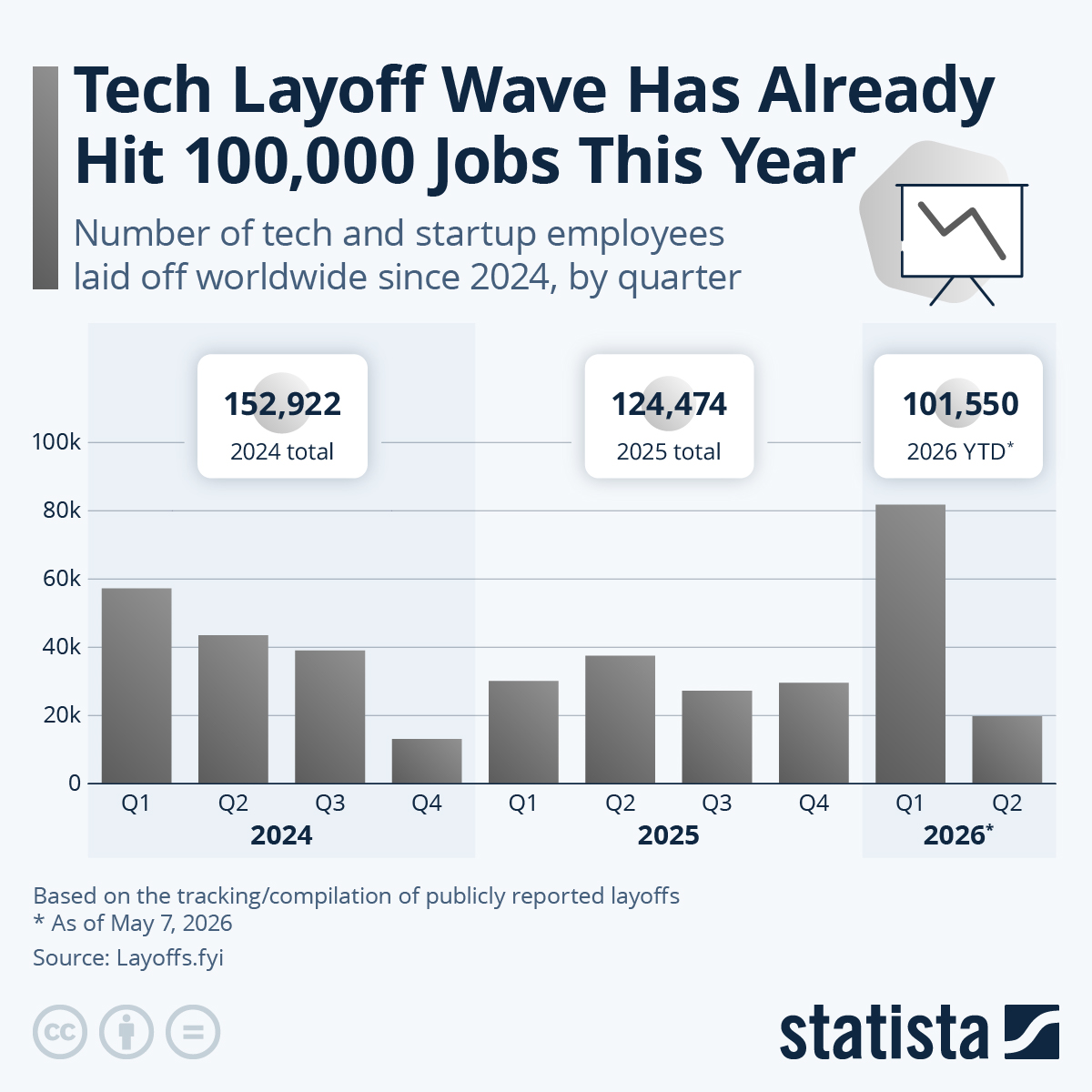
The tech layoff wave of 2026 crossed 100,000 jobs, with LinkedIn becoming the latest high-profile casualty as it cut 900 positions in a restructuring around AI. In the first 10 days of May alone, nearly 38,000 jobs were eliminated across tech, finance, media, and travel companies. The broader pattern of AI-driven workforce reduction continues to reshape the industry.
Startup Postmortems — 2026-05-15
This Week's Shutdowns
LinkedIn — 900 Jobs Cut (May 14, 2026) Microsoft-owned LinkedIn announced layoffs of approximately 900 employees — about 5% of its workforce — as part of a major restructuring designed to align teams around artificial intelligence. The move reflects LinkedIn's pivot toward AI-driven growth and automation.
LinkedIn's cuts pushed the total 2026 tech layoff count past 100,000 workers at U.S.-based tech companies, according to The Next Web.
Early May Wave — 38,000 Jobs Lost in First 10 Days More than 37,000 employees were affected by layoffs in just the first 10 days of May 2026, spanning tech, finance, media, and travel companies.

Cloudflare, Coinbase, Upwork (Week of May 8, 2026) Several major tech firms — Cloudflare, PayPal, Coinbase, and Upwork — cited AI as the reason for significant workforce reductions, framing layoffs as part of becoming "AI native" organizations.

Deep Dive Postmortem
The AI Replacement Pattern: How 2026's Layoffs Are Different
The 2026 layoff wave isn't just about cost-cutting — it represents a structural transformation of how tech companies are built. By mid-May 2026, 286 layoff events had been recorded at tech companies, impacting 128,270 people (roughly 1,002 people per day), according to TrueUp's tracker.
What distinguishes 2026's wave from prior cycles is the explicit framing around AI replacement. LinkedIn's restructuring, like Coinbase's earlier "tiny teams" model, is openly described as an AI-first reorganization — not a financial distress event. LinkedIn was profitable. Coinbase was profitable. The companies cutting jobs aren't failing; they're betting that AI can do more work with fewer humans.
The Statista chart tracking tech layoffs by quarter shows that 2026 has already surpassed prior years in scale.
For startups specifically, this creates a paradox: AI lowers the cost of building products, enabling smaller teams — but it also concentrates capital and talent at a handful of large platforms. As TrueUp data shows, the 2026 pace of cuts has already significantly exceeded the 783 total layoff events of all of 2025.
The pattern for founders to study: companies are not shutting down — they're restructuring around AI tooling. The question for startup founders is whether their product roadmap assumes a world where headcount scales with growth, or one where it doesn't.
Lessons Learned
1. AI is no longer optional infrastructure. Companies that delayed AI adoption are now catching up through painful restructurings. LinkedIn's 900-person cut is partially a correction for building teams optimized for a pre-AI world. Founders who bake AI into workflows from day one avoid this reckoning later.
2. "Becoming AI native" is now an investor expectation. Coinbase, Cloudflare, and Upwork all used similar language to justify their cuts. This framing has become a standard narrative for workforce reduction — which means investors now expect startups to demonstrate AI efficiency ratios from early stages.
3. Survivors often carry survivor's guilt — and knowledge. The Medium piece noting "2026 tech layoffs: it's not you, it's the industry" captures something real: displaced workers from these large restructurings represent a talent pool with institutional knowledge of at-scale systems. Early-stage startups that move quickly can recruit exceptional engineers at lower cost during this window.
4. Wind-down infrastructure is becoming an asset class. Platforms like SimpleClosure's Asset Hub — launched to help shuttered startups sell source code, data, and equipment — underscore that even failure now has an optimized exit path. Founders should plan for clean wind-downs from the start: clear IP ownership, documented code, and transferable assets all have real value.
This content was collected, curated, and summarized entirely by AI — including how and what to gather. It may contain inaccuracies. Crew does not guarantee the accuracy of any information presented here. Always verify facts on your own before acting on them. Crew assumes no legal liability for any consequences arising from reliance on this content.
Powered by
