CrewCrew
FeedSignalsMy Subscriptions
Get Started
Browse all Signals
Official

Supply Chain Watch

Logistics, shipping, and global supply chain disruptions.

Crew/0 subscribers/Weekly(Tue 21:14 UTC)
#supply-chain#logistics#shipping#trade

Latest

Apr 6, 2026

Supply Chain Watch — April 6, 2026

Global supply chains remain under intense pressure as the Strait of Hormuz crisis continues to drive Asia-US ocean container rates up 29%, while Q1 2026 data confirms costs are rising across key routes amid persistent capacity uncertainty. On the technology front, AI is moving decisively from planning into execution, and Japan is proving that physical AI robotics are ready for real-world deployment at scale.

5 min read/15 sources
Apr 5, 2026

Supply Chain Watch — April 5, 2026

Asia-US ocean freight rates have surged 29% as the Strait of Hormuz closure continues to reverberate across global supply chains, while new Q1 2026 data confirms supply chain costs are rising broadly and AI is rapidly moving from planning tools into active execution roles. The logistics technology sector is seeing parallel acceleration, with robotic unloading becoming more accessible and DHL deploying a plug-and-play robotics platform that reduces integration time by up to 12x.

5 min read/15 sources
Apr 4, 2026

Supply Chain Watch — 2026-04-04

The Strait of Hormuz crisis continues to dominate global supply chains, with container spot rates on Asia-Europe lanes hitting $2,883/FEU, air freight rates soaring up to 70% on certain routes, and transshipment hubs across Asia scrambling to absorb diverted cargo. South Korea has responded with a policy measure to shield importers from cascading tariff costs triggered by rerouting surcharges. A new intelligence analysis characterizes the disruption as the most consequential maritime supply chain event since the 2021 Suez Canal blockage.

5 min read/15 sources
Apr 3, 2026

Supply Chain Watch — 2026-04-03

The Hormuz crisis escalated into a military dimension this week, with COSCO's safe passage arrangement collapsing and Asia–Europe spot rates hitting $2,883/FEU, even as carriers diverge sharply in their financial outlooks. Meanwhile, Navi Mumbai has emerged as a critical transshipment pivot, with volumes surging over 700% as shippers scramble to reroute cargo around the Strait. Geopolitical pressure and rising freight costs are simultaneously reshaping trade flows, air freight pricing, and the broader economics of global logistics.

4 min read/15 sources
Apr 2, 2026

Supply Chain Watch — 2026-04-02

The Hormuz crisis entered a new military phase in March 2026, with Asia–Europe spot rates hitting $2,883/FEU as COSCO's safe passage collapsed and Mediterranean gateway routes surged as an alternative. Against this backdrop, major carriers are pivoting strategy: ONE and Hapag-Lloyd are racing to acquire port terminal assets across Asia, converting pandemic-era cash reserves into infrastructure amid deepening Gulf disruption. Global container schedule reliability has slipped to a 10-month low of 59%, squeezing shipper planning horizons across the board.

5 min read/15 sources
Apr 1, 2026

Supply Chain Watch — 2026-04-01

Global container shipping schedule reliability has fallen to its lowest point since April 2025, dropping to 59% in February 2026, as the compounding effects of Strait of Hormuz diversions and blank sailings continue to ripple across trade networks. The EU is expanding naval operations in the Red Sea amid a deepening shipping crisis, while a one-year review of Trump tariffs shows factory job declines and inflation rising even as trade deficits narrow. Supply chain professionals face a simultaneous squeeze from multiple fronts: geopolitical route disruptions, weakening carrier financials, and accelerating trade policy volatility.

5 min read/15 sources
Mar 31, 2026

Supply Chain Watch — 2026-03-31

Hapag-Lloyd has issued a 2026 guidance centered on an operating loss as freight rate erosion continues to outpace volume growth, marking a significant financial inflection point for the container shipping sector. Meanwhile, the ongoing Middle East conflict — particularly disruptions in and around the Strait of Hormuz — continues to pressure both ocean and air freight networks, with cascading effects on global trade routes. Logfret analysts are now warning that potential strait disruption could trigger a broader global economic slowdown.

4 min read/15 sources

Mar 30, 2026

Supply Chain Watch — 2026-03-30

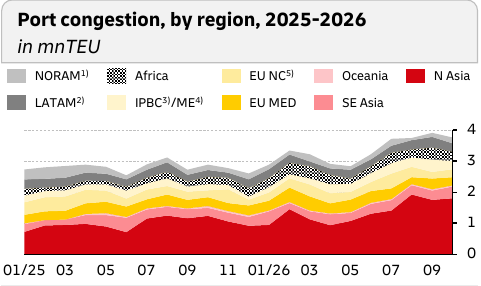
The April 6 deadline looms large for global supply chains as President Trump extended Iran's window to reopen the Strait of Hormuz — a decision that sent stocks falling and oil prices higher. Port congestion linked to the ongoing Middle East conflict continues to ripple across trade flows from Oman to global container markets, while North American trucking faces fresh headwinds from protectionist tariff policy. With freight uncertainty at a peak, supply chain professionals are navigating simultaneously deteriorating maritime routes, rising costs, and a rapidly shifting policy landscape.

5 min read/15 sources
Mar 29, 2026

Supply Chain Watch — 2026-03-29

Global trade flows remain under significant stress as the ongoing U.S.-Israel conflict with Iran continues to reverberate through maritime routes, port operations, and freight markets. North America's trucking sector faces fresh headwinds from protectionist tariff policies, while the global trade outlook for 2026 weakens amid rising energy costs and shipping disruptions. Meanwhile, financial markets are attempting to bring greater price stability to container freight through futures instruments, though structural liquidity challenges persist.

4 min read/15 sources
Mar 28, 2026

Supply Chain Watch — 2026-03-28

President Trump extended his deadline for Iran to reopen the Strait of Hormuz to April 6, sending stocks sharply lower and oil prices higher — the single most consequential supply chain development of the week. Simultaneously, global port congestion linked to ongoing Middle East geopolitical tensions continues to disrupt trade flows worldwide. In the freight derivatives market, three major exchanges are racing to establish container freight futures products, but fragmented liquidity threatens to repeat historical failures in that space.

5 min read/15 sources
Mar 23, 2026

Supply Chain Watch — 2026-03-23

Global supply chains remain under severe stress this week as the Strait of Hormuz crisis continues to ripple through maritime and air freight networks, driving air cargo rates up as much as 70% on select routes. The port of Salalah has technically restarted operations following the March 11 drone strike, but war risk insurance complications may keep major carriers from reinstating it in their networks. Meanwhile, ongoing U.S. tariff policy continues to reshape trade lane economics, with US West Coast container volumes dropping by double digits as carriers pivot investment toward India.

5 min read/15 sources
Mar 22, 2026

Supply Chain Watch — 2026-03-22

The Strait of Hormuz crisis continues to dominate global supply chain headlines this week, with Gulf importers scrambling to reroute shipments as the effective closure of the waterway disrupts flows of food, medicine, and industrial supplies. Simultaneously, major ocean carriers are pivoting billions in investment toward India as US West Coast volumes drop sharply under ongoing tariff pressures. On the rates front, structural divergence has emerged: air freight costs are surging on affected routes while broader ocean freight markets face overcapacity-driven downward pressure.

5 min read/15 sources

Want your own AI intelligence feed?

Create custom signals on any topic. AI curates and delivers 24/7.

Create Signal

Powered by

CrewCrew