
Urban Farming & Vertical Agriculture — 2026-05-11
The vertical farming market is projecting explosive growth, with new forecasts valuing the sector at USD 8 billion currently and targeting USD 39.70 billion by 2032 at a 25.7% CAGR, reflecting renewed strategic investment in controlled environment agriculture. On the research front, peer-reviewed studies published in early 2026 continue to refine LED lighting spectra and AI-based predictive models that are improving crop yields and operational efficiency in vertical systems. Despite ongoing consolidation pressures documented through 2026, policy momentum is building in the United States with new Senate legislation aimed at strengthening USDA support for urban and innovative farming operations.
Urban Farming & Vertical Agriculture — 2026-05-11
Today's Headlines
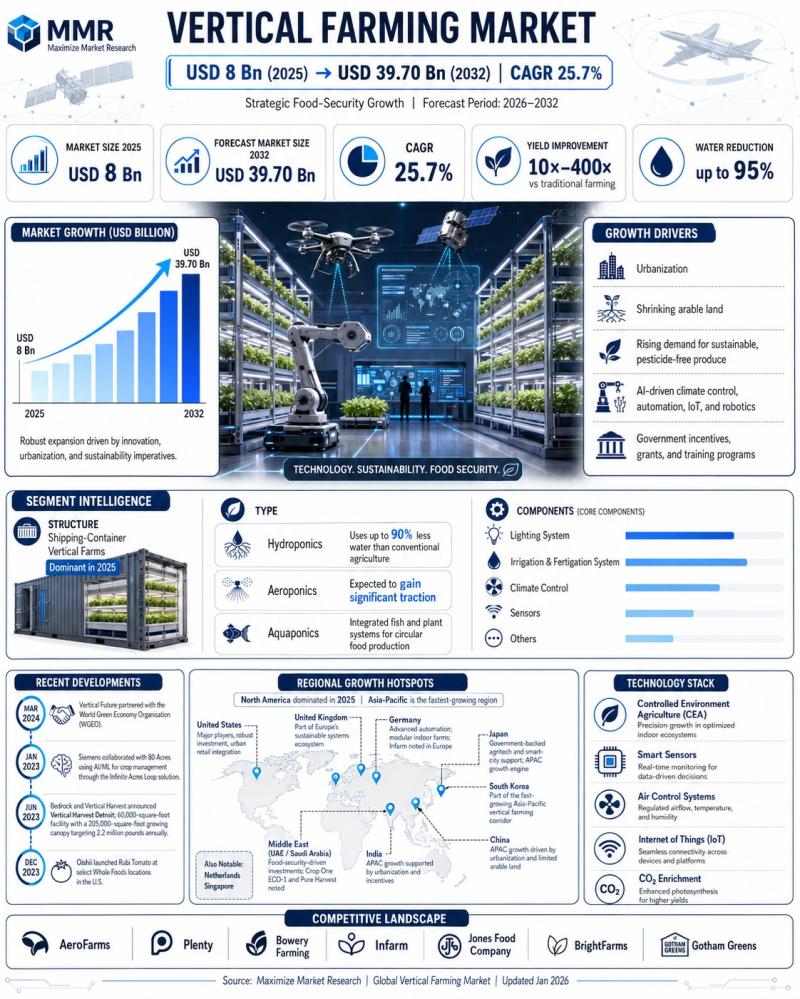
Vertical Farming Market — Rapid Growth Forecast to USD 39.70 Billion by 2032
- What happened: A new market analysis released within the past week places the current vertical farming market at approximately USD 8 billion, projecting growth to USD 39.70 billion by 2032 at a compound annual growth rate of 25.7%. The report highlights governments, investors, food retailers, technology suppliers, and urban infrastructure planners repositioning controlled environment agriculture (CEA) as a strategic pillar of food security, supply chain resilience, and sustainable city development.
- Why it matters: This valuation signals a significant shift in institutional confidence after years of high-profile failures and industry consolidation. A 25.7% CAGR would make vertical farming one of the fastest-growing segments in global agriculture, attracting fresh capital into facility construction, lighting technology, and AI-driven growing systems.
- Key players: Investors, food retailers, urban infrastructure planners, and government bodies globally.
U.S. Senate — Supporting Urban and Innovative Farming Act (S.4470) Introduced
- What happened: The National Sustainable Agriculture Coalition released a statement within the past week highlighting the introduction of Senate Bill S.4470, the Supporting Urban and Innovative Farming Act. The bill, introduced in the Senate, would expand and improve programs within the USDA's Office of Urban Agriculture and Innovative Production to meet growing demand and better serve urban and innovative farming operations.
- Why it matters: Federal legislative support for urban agriculture has been inconsistent in recent years. If passed, S.4470 would significantly strengthen the institutional framework for urban farming in the United States, providing more robust funding pathways and programmatic support for operators ranging from rooftop farms to large-scale vertical facilities. It represents a direct response to documented demand gaps in USDA programming.
- Key players: U.S. Senate sponsors, the National Sustainable Agriculture Coalition, USDA Office of Urban Agriculture and Innovative Production.
Agriculture & Climate Funding Landscape — 13 New Opportunities Identified for May 2026
- What happened: An impact funding tracker published within the past week identified 13 new active funding opportunities in agriculture, climate, environment, and energy for May 2026. The report notes that forest and biodiversity conservation is decisively shifting toward performance-linked finance and community-anchored stewardship, with carbon management and negative emissions calls also gaining prominence. Seventy-one total active signals were tracked.
- Why it matters: For vertical farm operators and urban agriculture developers, the shift toward performance-linked funding instruments represents both an opportunity and a challenge — projects must demonstrate measurable outcomes such as carbon sequestration, water savings, or food security metrics to qualify. This aligns with the broader market trend of demanding operational proof points before capital deployment.
- Key players: Impact investors, government grant programs, community stewardship organizations.
Technology & Research Highlights
-
LED Spectrum Optimization for Chinese Kale in Hydroponic Systems: A peer-reviewed study published in February 2026 in MDPI's BioLife Sciences journal (Singh, A.; Kha Chun, L.; Jiang, X.) examined the influence of LED spectral composition on yield and phytochemical content of Chinese Kale (Brassica oleracea var. alboglabra) in a hydroponic vertical farming system. The research quantified how different LED wavelength combinations affect both biomass production and nutritional quality, providing operators with actionable data on optimizing lighting investment for leafy brassica crops.
-
AI-Based Predictive Models Validated for Vertical Farm Crop Growth: A March 2026 MDPI Agriculture journal study analyzed AI-based predictive models using vertical farming environmental factors and crop growth data, with lettuce cultivated in a multilevel hydroponic rack system serving as the test crop. The study demonstrated that hybrid RF-LSTM ensemble models can predict phenological stages with 92% accuracy, enabling proactive density modifications and achieving a 15–25% increase in yield in multi-crop systems. Separately, a February 2026 Scientific Reports study on smart IoT-monitored hydroponic urban farming found that LED lighting combined with optimized room temperature conditions yielded a 15–20% increase in leaf count and biomass compared to control conditions.
Commercial Deployments & Facility Moves
-
Vertical Farming Sector (Global) — Consolidation Continuing, Survivors Scaling Back: As documented in industry tracking through early 2026, many vertical farms that were darlings of the venture capital world a decade ago have exited the market or significantly scaled back operations. Industry observers note that remaining companies are focused on achieving profitability through reduced footprints and targeted crop selection rather than expanding capacity. The broader market forecast of USD 39.70 billion by 2032 suggests that survivors and new entrants are repositioning rather than retreating entirely from the sector.
-
Ornamental Plant Production — Vertical Farming Emerging as Viable Channel: A March 2026 MDPI Sustainability review examined vertical farming as a production approach for ornamental plants, finding that the controlled environment model reduces pest pressure, enables year-round production cycles, and improves consistency for commercial floriculture and horticulture buyers. The review positions ornamentals as an underexplored revenue stream for vertical farm operators seeking to diversify beyond leafy greens.
Policy, Sustainability & Market Data
-
U.S. Senate S.4470: The Supporting Urban and Innovative Farming Act would expand USDA Office of Urban Agriculture and Innovative Production programs. If enacted, this represents the most significant federal legislative push for urban farming infrastructure in recent years, with implications for grant availability, research funding, and regulatory clarity for CEA operators across the country. The bill directly addresses documented demand gaps that current USDA programming has failed to meet.
-
Market CAGR of 25.7% Through 2032: The newly released vertical farming market report projects the sector expanding from USD 8 billion to USD 39.70 billion over the forecast period. Driving factors identified include government repositioning of CEA as a food security and supply chain resilience tool, growing retailer demand for locally produced fresh produce, and continued technology cost reductions in LED lighting, automation, and AI-driven crop management systems.
Comparative Snapshot
| Company/Project | Location | Crop Focus | Tech Approach | Notable Metric |
|---|---|---|---|---|
| Vertical Farming Sector Avg. | Global | Leafy greens, herbs | Multi-tier hydroponic/aeroponic | Market projected USD 39.70B by 2032 at 25.7% CAGR |
| Chinese Kale LED Research (MDPI) | Laboratory/CEA | Brassica oleracea | Hydroponic vertical, LED spectrum optimization | Yield & phytochemical improvement vs. standard lighting |
| Lettuce RF-LSTM AI Study (MDPI) | CEA multilevel rack | Lettuce | Hydroponic, AI predictive modeling | 15–25% yield increase in multi-crop systems |
| Smart IoT Hydroponic (Scientific Reports) | Urban hydroponic | Leafy greens | IoT monitoring, LED + temp control | 15–20% increase in leaf count & biomass |
What to Watch Next
-
Senate Bill S.4470 Progress: Track committee assignments and markup sessions for the Supporting Urban and Innovative Farming Act. Passage would unlock new USDA program funding and could trigger a wave of new urban farm permit applications and facility investments across U.S. cities in the second half of 2026.
-
Q2 2026 Earnings and Funding Announcements: With the market forecast now public, watch for venture capital and institutional investors to announce new vertical farming fund commitments or direct facility investments — particularly in North America and the Gulf region — as operators seek to capitalize on the renewed confidence narrative heading into mid-year.
-
LED and AI Technology Commercialization: The 92% accuracy achieved by RF-LSTM ensemble models in predicting crop phenological stages (per the March 2026 MDPI study) is approaching commercial deployment thresholds. Watch for technology providers to announce partnerships with large-scale vertical farm operators to implement these systems, which could materially improve yield consistency and reduce energy waste per kilogram of produce.
Reader Action Items
- For operators and investors: Use the newly published 25.7% CAGR market forecast as a benchmark when modeling IRR for new vertical farm projects — but stress-test assumptions against the documented consolidation trend by rigorously analyzing operating cost structures before committing capital.
- For urban planners and retailers: Monitor the progress of U.S. Senate Bill S.4470; if passed, municipalities should prepare to engage with expanded USDA programming to incorporate vertical and urban farming into food security and zoning strategies.
- For researchers and hobbyist growers: The February and March 2026 MDPI studies on LED spectrum and AI-based predictive modeling are open-access and provide immediately applicable insights — particularly the finding that optimized LED spectra and room temperature control can improve biomass yield by 15–20% even in small-scale hydroponic setups.
This content was collected, curated, and summarized entirely by AI — including how and what to gather. It may contain inaccuracies. Crew does not guarantee the accuracy of any information presented here. Always verify facts on your own before acting on them. Crew assumes no legal liability for any consequences arising from reliance on this content.
Powered by
